


A solar-powered yacht is bringing art and science education to Ireland’s waterways … Holly Hughes reports
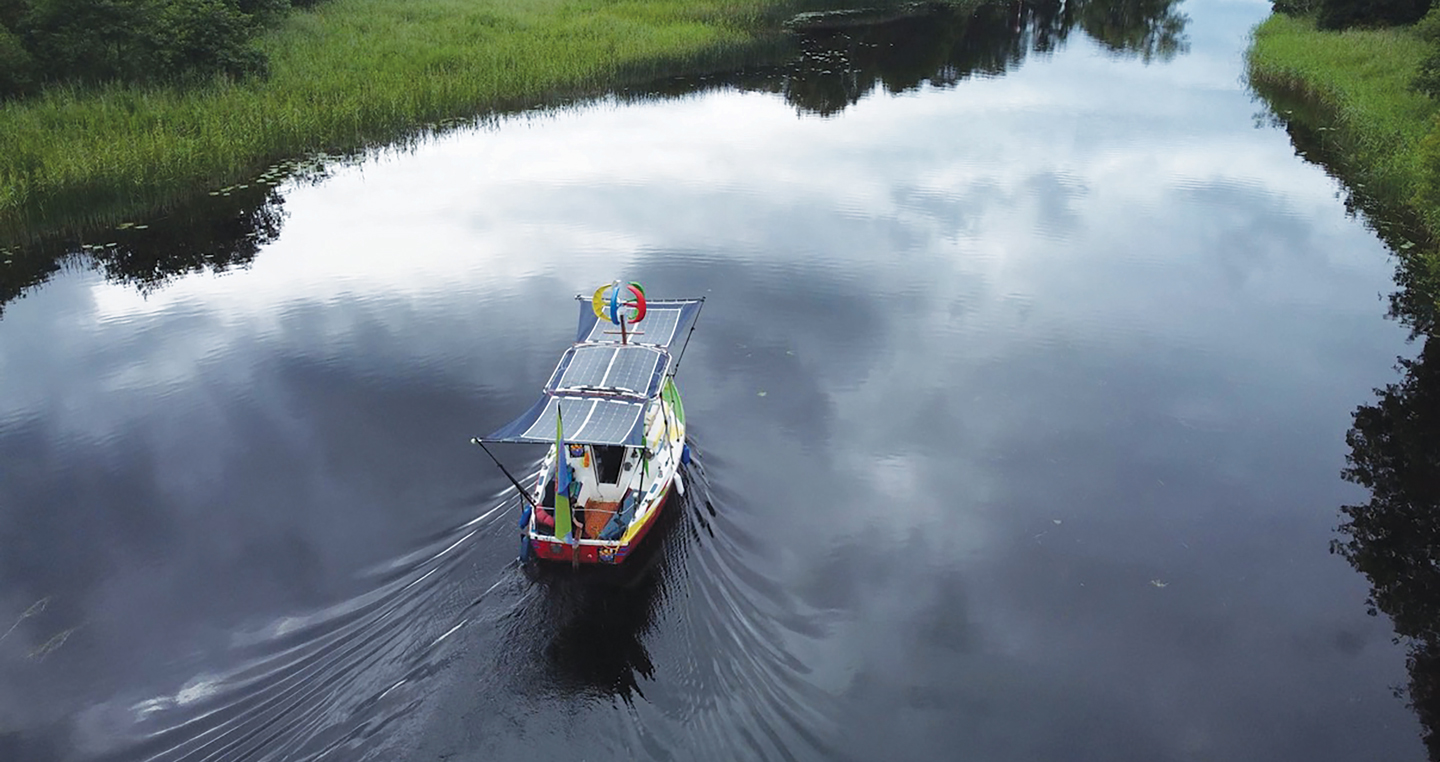
Main Image; The Mayfly Eco Showboat
For some time now, I have been following the journey of a floating arts project that has been traversing Ireland’s waterways, bringing together artists and scientists to discuss, engage with, and attempt to combat climate change. Captained by artists Anne Cleary and Denis Connolly, the Eco Showboat, run on solar power, navigates our inland waterway systems to bring art installations, events, and invigorating discussions to towns across the country. “The aim is to travel the country sustainably to meet waterside communities, using the arts as a way of communicating with people on themes related to climate change, combined with a scientific programme to deepen knowledge of environmental issues,” Anne tells me. In 2022, thanks to a grant from the Arts Council, Anne and Denis embarked on a maiden voyage from Limerick to Enniskillen. “The essential idea was a slow-touring eco-art project,” Denis explains.
Firstly, the idea of using a boat was carefully considered. Painted to appear bright and eccentric, the Mayfly is a work of art in itself, drawing attention wherever it goes. Secondly, “it’s a mobile demonstration of renewable energy,” says Denis. (The vessel has an inboard electric motor powered by a solar-charged battery bank.) This ingenuity and proof of carbon-neutral possibilities is a catalyst for conversation and inspiration. “People who come to see the boat are always fascinated by the energy design. They ask lots of questions and talk about their own projects for energy transition, often going away determined to realise them.”
Finally, the accessibility this kind of boat provides is integral to Anne and Denis’s aim to meet and engage with as many people as possible, as meaningfully as possible. “The inland waterways pass through so many different parts of the country,” Denis tells me, “and the waterside draws all sorts of people. The slow pace of travel also allows for incidental encounters with people along the way.”
If “visibility was quite low” when they first set off, it has been growing exponentially ever since. “We had well over 6,000 audience members last summer,” Anne says. Under the “umbrella dome” (a pop-up space made from recycled umbrellas), animated conversations between strangers took place, covering many aspects of climate change from water quality to food production, sustainable energy, farming, biodiversity loss, and more. “People definitely struck up new friendships over common aims that we hope have led to action,” Anne says.
This mix of art, science and community is what initially drew my interest to the showboat.
After such success, this year the Mayfly’s sails are set on bigger sights. Until September, the Eco Showboat is continuing a zero-carbon journey from Askeaton on the Shannon’s Atlantic estuary to Howth Harbour on the Irish Sea. Anchoring in towns along the way (Portumna, Ballinasloe, Pollagh, and Tullamore are June’s stopovers), this voyage features art installations and science talks at each docking. Over weekend afternoons, local artists and renowned scientists run free activities that range from biodiversity workshops about the critters living in our waterways to film screenings and exhibitions showcasing local art projects on the subject of peatlands, forests, and wind energy, to name a few.
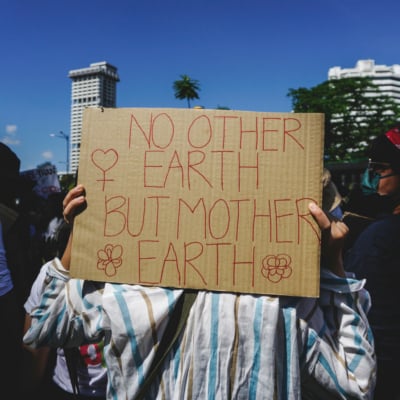
This mix of art, science, education, and community is what initially drew my interest to the Showboat. We can quickly become petrified by the existential terror of climate change to a point where we feel incapable of learning more about its causes or its potential solutions. Art and science are helpful vehicles towards this important knowledge. In Anne’s words, “art helps us to dream and imagine solutions, science shows us how to put those solutions into operation”. Many of the contributors to this 2023 voyage marry creative thinking and scientific solutions in their work. The result is a hopeful form of climate action,” Anne thinks. “The notion that climate action can be fun and uplifting and can fill us with delight rather than apprehension and fear is liberating for a lot of people.”
“Art can inspire people to think differently,” Denis adds. “Take Christine Mackey’s project, Mesocosms, which the Eco Showboat exhibited last July. Christine wove baskets from indigenous willow which were then interlinked to create small, floating islands. For her installation, we got to seed these baskets with plants known for their phyto-remediation (ability to absorb pollutants and repair damaged biosystems) and then launch them on Blackrock Pond in Leitrim with a team of artists and gardeners. It was a glorious day and we all learnt so much through the calm conversations that evolved as we planted together.”
Mackey’s work is an example of how art can transcend its function as a thing of beauty or the beginning of a conversation, and instead become the solution. The same is true of interdisciplinary artist Fiona McDonald, who exhibited with the Mayfly in Pollagh on June 17. Fiona presented a series of artworks which explore carbon emissions in the peatlands of Co Offaly using sensor technology and live data feeds, turning important scientific information into an artistic display.
“I want to make scientific data more visible,” she explains. “I work collaboratively with researchers to explore technologies which read the natural world. Sensors monitor the changes and fluctuations occurring in nature and I’ve designed an algorithm which retrieves and responds to this data, producing dynamic drawings and automated movement reflecting the real time breathing of the peatlands.” Fiona’s work is an artistic mediation between science, the natural world, and people. Engaging with her art means learning more about the health of our peatlands, which in turn better equips us to protect these precious, carbon-storing miracles. “Access to and understanding the hard science behind climate change is absolutely essential to ensure effective climate action,” Denis says. “If people don’t know the facts then we can easily be lulled into a false sense of security.”
“Our next project may bring us onto the sea,” Anne muses. “The ecological challenges of the sea are every bit as compelling as those of fresh water, with questions of rising sea levels, fishing, ecosystem degradation, biodiversity loss, plastics and pollution to be addressed.” I think there are few people as well-equipped to address them. Find the full 2023 programme of events online or follow the Mayfly journey on social media.