Meet The Cast Of Conor McPherson’s Masterpiece, The Brightening Air
By The Gloss
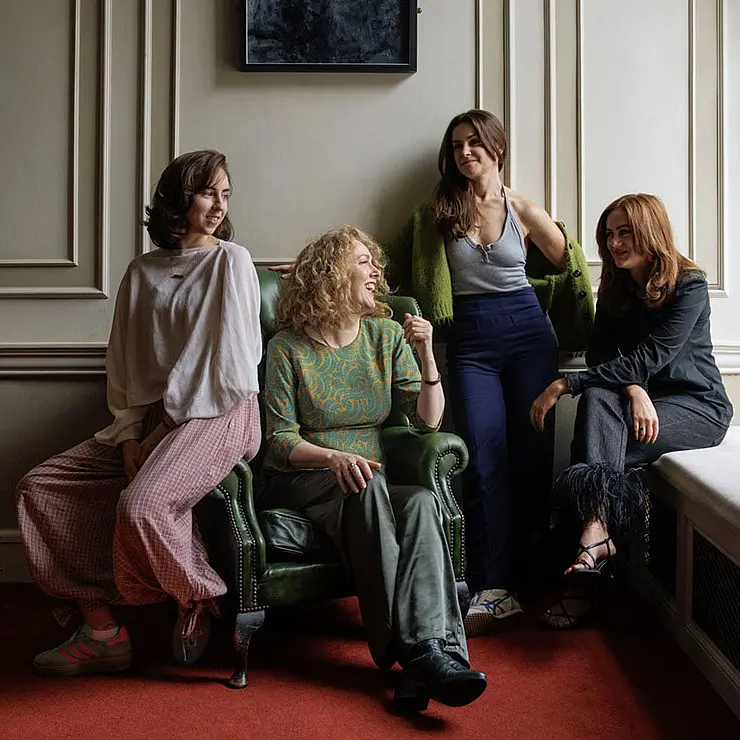
Behind the scenes with Derbhle Crotty, Judith Roddy, Aisling Kearns and Kate Gilmore …
There were self-actualised women living impressive, independent lives in early 1980s Ireland – but the female characters of The Brightening Air, a new play by Conor McPherson that begins its Dublin run at the Gate Theatre, sadly do not belong to that lot.
“You had the Irish Countrywomen’s Association, and you had women running businesses,” points out Derbhle Crotty, who plays Elizabeth, a wayward priest’s housekeeper, “but in this play they’re not doing any of that.”
In fairness, things aren’t much better for the men in the piece. The Brightening Air, set in 1981, is a play about three dysfunctional siblings (Dermot, the eldest and the most odious, is played by Chris O’Dowd in a rare stage outing) and the damp, crumbling farmhouse they grew up in. Add a downtrodden wife, a blind uncle who’s been barred from the priesthood, his bizarre housekeeper (Crotty), and a few overlapping love interests and you’ve got yourself a hit. McPherson, one of Ireland’s most esteemed living playwrights (1997’s The Weir made him a star and almost 30 years on, it still captivates audiences), has created a show that is as hilarious as it is heartbreaking. When it opened at The Old Vic Theatre in London last year, it was heaped with praise, with the Financial Times calling it a “rich family drama with echoes of Chekhov”.
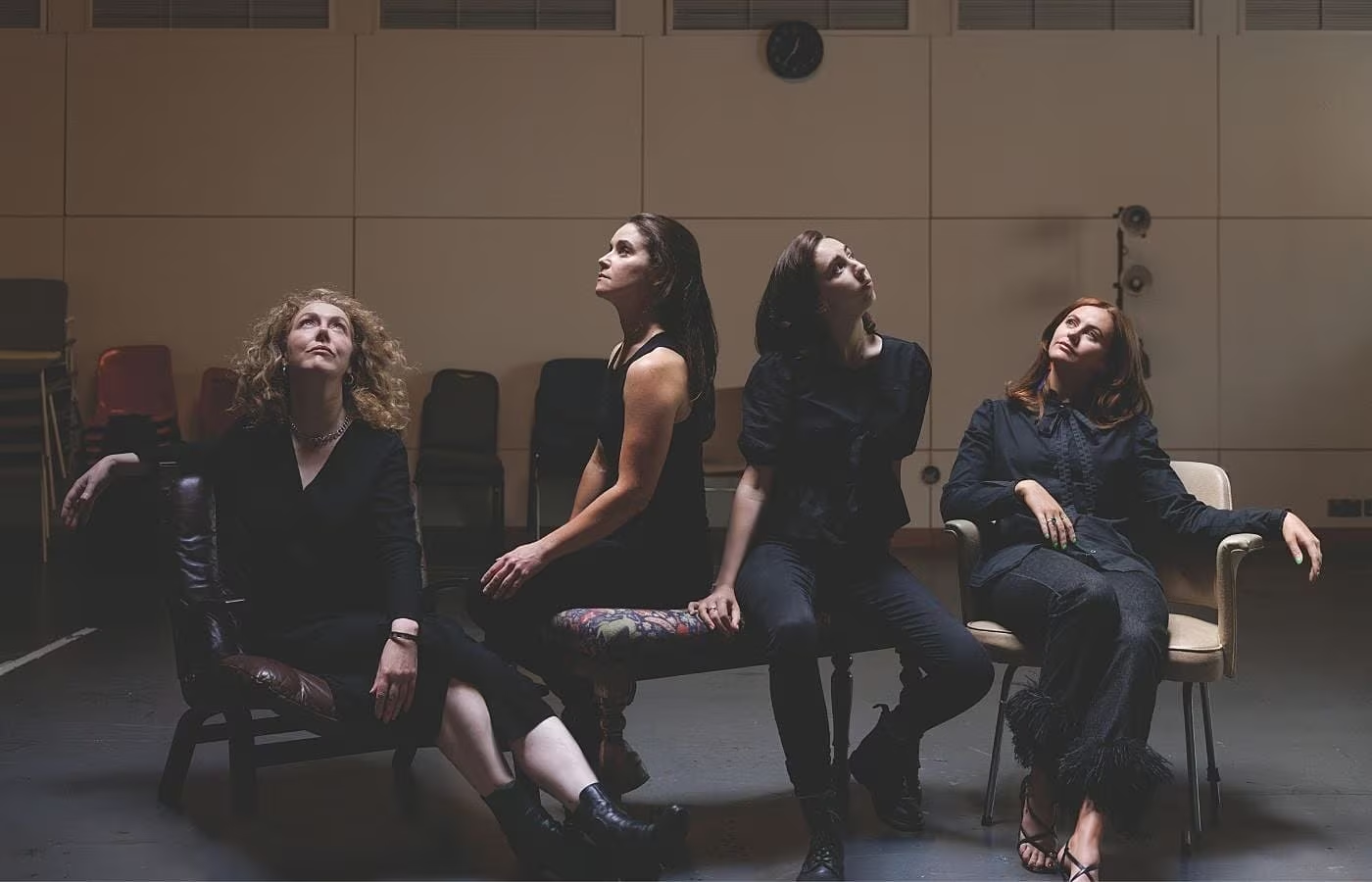
I’m talking to Crotty, a stalwart of the Irish stage, alongside the three other women appearing in the ensemble piece. Aisling Kearns is Freya, Dermot’s much younger love interest (Crotty and Kearns played the roles in The Old Vic); Judith Roddy plays Dermot’s sadly, almost pathetically loyal wife, Lydia; and Kate Gilmore is Billie, his spiky but vulnerable sister.
The roles give the actors interesting, complicated work to do. “And they’re funny,” points out Crotty. “It’s something that I love in a character, and it’s true for all of these characters – they have a sense of humour.”
When I ask her what drew her to the job in particular, Crotty hoots. “It’s a no-brainer. I mean, Conor is an extraordinary writer. It’s a luxury offer. It’s not really about being drawn to it, it’s more the kind of thing you’d crawl over people for, commit a few kidnaps for!”
The others are similarly enthusiastic, with Kearns proclaiming that it’s the “stuff you dream about”. They’re all excited to be working on such rich material and they have genuine affection for their characters, messed up as they may be.
Crotty recalls a friend coming to see the show during one of the earliest performances in London, when she was still finding her feet in the role, and asking why her character Elizabeth “doesn’t just leave” the abject situation she’s found herself in.
“I thought, ‘Leave and go where? Do what?’,” says Crotty. “I think we can delude ourselves that there are so many options, even now, that people can choose their lives and just remake them as they please.”
The Brightening Air’s female characters are largely out of options and they’re just trying to find a way to survive, whether that means reciting train timetables aloud like neurodivergent Billie or becoming romantically involved with an older local businessman like Freya.
Roddy’s Lydia is tragically optimistic, even as she remains married to a man who cares so little for her. “I really like her sense of hope,” Roddy says of her character. “She’s always coming in with the solution, she’s keeping the ball in the air – but the thing that she wants is the thing that’s going to cage her. It’s like her sense of hope is the thing that’s going to deflate her.”
We move on to talk about the options available for female theatre practitioners in Ireland today. It’s been over a decade since the #WakingTheFeminists campaign was formed in response to the Abbey Theatre’s male-dominated 2016 programme (which featured only one play written by a woman) with women in Irish theatre demanding – and gaining – better representation. Crotty was heavily involved at the time, speaking at the public meeting held at Abbey Theatre that galvanised the movement.
Irish theatre has changed in the years since: Roddy points out that the two biggest theatres in Dublin now have female artistic directors – Róisín McBrinn at the Gate and Caitríona McLaughlin at the Abbey. Things have changed for the better overall, agrees Crotty – but it’s a case of “some down, plenty more to do.” Looking back, she’s struck by how being part of such a large movement – “a critical mass, an avalanche” as she puts it – allowed for a collective boldness. “I don’t think that has lasted,” she says ruefully. “Theatre is a small, very personal business …”
Each of these women are very aware that they’re in a profession that offers little security: as an actor, even when you’re as talented and garlanded as these women are, you’re waiting to be “chosen”, as Crotty puts it. “You get chosen every time – or not chosen,” she says. “You’re on the list or you’re not on the list.”
Gilmore has founded her own film and TV production company with her friend and fellow actor Fionnuala Gygax, as a way of having more control over her own career. An actor can be “the cream of the crop” for a time, but then “you’re out of the building”, she says. “You can feel disposable. So I thought producing work could feel more stable and rewarding.”
“As Derbhle says, you’re chosen or not chosen, and I was not chosen for a long time, so I chose myself,” she reflects. “I started writing vehicles for me – but then go, hang on a minute, having a voice is addictive. Because, as an actor, you’re a vessel for a vision. If you start writing, you realise, Oh, I have things in me that I want to say. Then more and more ideas come.”
The last time Roddy was on the Gate stage was during the spring covid lockdown in 2021 – the stalls were empty and The Visiting Hour, a care home drama co-starring Stephen Rea, was streamed to audience members who were watching the live show on their laptops. It was a project that she spearheaded.
“Stephen and myself had worked together a few times, and I rang him during lockdown, and we talked about how we should do a two-hander. So we asked Frank McGuinness to write us a play!” she remembers, almost amused by her own audacity. “It’s funny when you’re backed up against the wall – you realise your capacity, because otherwise you just have to wait for a phone call …”
Kearns creates her own work on social media – she has hundreds of thousands of followers on Instagram and TikTok who are there for her humorous short form content. Her recent video about the specific type of plastic bowl that has multiple uses in an Irish home (popcorn receptacle, vessel to catch leaks, reservoir for children’s vomit, etc) has been viewed millions of times.
Her social media success provides a welcome source of income that keeps her afloat when she’s not earning from acting work. However, she thinks the pressure for actors to have a large social media following – it’s not unheard of for commercial TV and theatre projects to enquire about a potential star’s social media following before casting them – is “bullshit”.
“I loved the way Paul , just as he got really big, deleted all his public social media – because you shouldn’t have to have it,” she says.
Social media can “feel toxic for actors”, Kearns observes. “There’s a lot of comparing, especially in those times when you haven’t been chosen, and you’re thinking, ‘Oh my god, they’re doing this’ and ‘I didn’t get seen for that’. It can be really hard. I don’t think actors should have to be on social media, and have a certain number of followers. That’s just crazy.”
Roddy and Crotty stay off social media and Gilmore is on Instagram but has conflicted feelings about it. “It’s almost like it’s like a fake simulation version of yourself,” she says. “It’s you, if life went really well all the time.”
As we prepare to wrap up the interview, talk turns to the rehearsal period. Roddy and Gilmore are new in the roles, while most of the rest of the cast, including Chris O’Dowd and Brian Gleeson, performed in the show in London. “It’s like coming on at half time in a football match,” jokes Roddy. “But you know the team are already winning with this production.”
“You’re coming in with less rehearsal time, and with people who already know it,” says Gilmore. “So it feels exposing and thrilling at the same time. You just have to throw yourself in.” She met McPherson recently and confessed that she was feeling apprehensive about the task ahead. “He said, ‘That’s like me every time I sit down to write something.’”
Crotty tells them about a warm-up ritual the London cast carried out before each performance. They would gather on stage before the audience had been admitted to the theatre and sing a song one cast member had chosen before each performance: “We would be on stage singing and dancing, and it’s a cool thing to be on a stage when the stalls are empty and ushers are checking for the last bits of rubbish and practising the fire announcements. It’s special.”
She hopes to continue the tradition alongside Roddy and Gilmore in Dublin. The Brightening Air is at the Gate Theatre from July 17.
SEE MORE: An Exclusive With Hollywood Costume Designer Ellen Mirojnick