



Amuse Bouche, a delightful new book by food writer Carolyn Boyd, will have you salivating – and plotting your next trip to France…
“Tell me what you eat, and I’ll tell you what you are,” wrote Jean-Anthelme Brillat-Savarin.
These are perhaps the most famous words ever written about what we choose to put on our plates. Yet give the renowned 19th-century gastronome’s words a slight tweak – tell me what you eat, and I’ll tell you where you are – and they could equally apply to France. For wherever you are in this great gastronomic nation, you can be sure there is a food that tells you a story about the place you are in. It’s through these stories that I have fallen in love with France and come to appreciate how deeply food is woven through its society, how its people are brought together around the dining table and how it represents itself to the world.
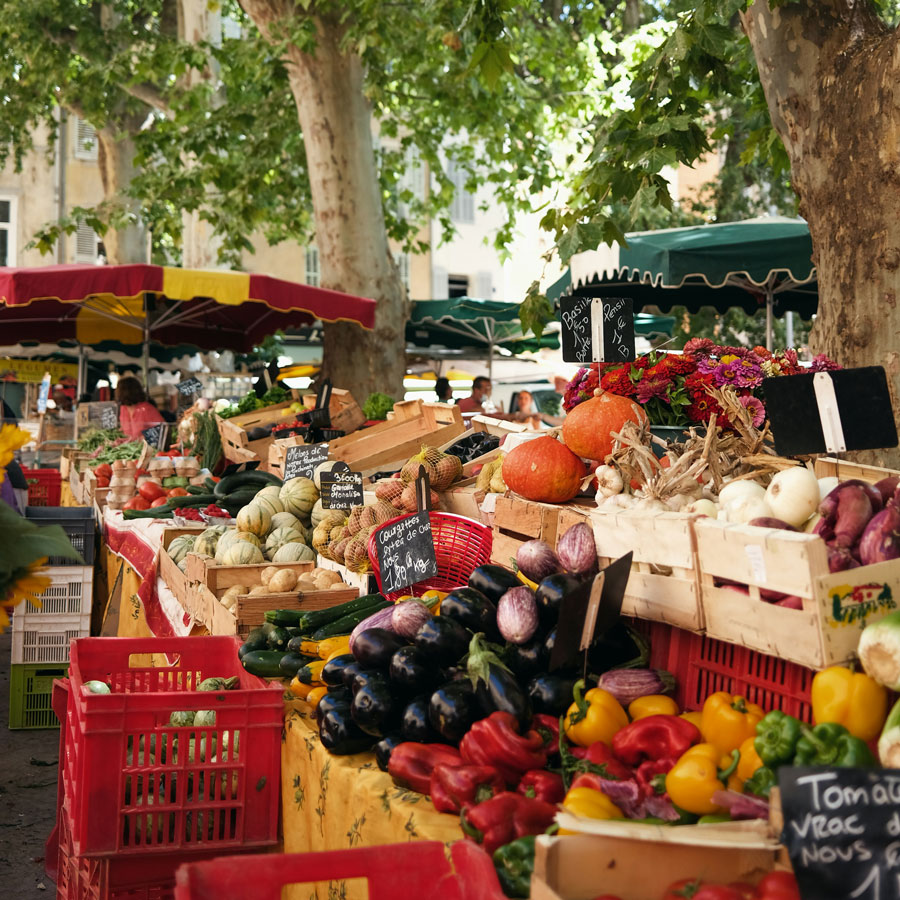
I have loved France for as long as I can remember: family camping holidays opened my eyes to the joy of the croissant slathered in cool creamy butter and sweet strawberry jam, and the sting of the salt on my lips when eating a poolside barquette de frites. Discovering France, with its buzzing local markets and the whirl of black-clad waiters serving busy café terraces, implanted an early sense of wanderlust which led to a career writing about exploring France and its food. The recommendations and experiences here have been gathered through my career, during which my travels have taken me to almost every part of the country and allowed me to dine in some of the best restaurants for every budget, as well as tables d’hôtes, bars à vins and picnic spots. I have talked to hundreds of producers, bakers, cooks and chefs to get a better understanding of their products and cuisines and how to enjoy them. I have peered into fields, donned hairnets and overalls to visit dairies, sloshed around fishing ports and estuary mudflats, tramped across farms and browsed dozens of markets with the aim of better understanding the many different foods on offer.
Even after visiting countless times, I still feel a frisson of excitement each time I arrive on French soil; my heart swells at seeing its varied landscape, at stepping into its shuttered maisons and at tuning into the language, taking my first sip of a kir, or a bite of salt-flecked Breton butter on bread. As the most visited country in the world, France’s allure and appeal has much to do with its variety; when it comes to choosing a holiday in France the options can be as wide-ranging as a trip to the Île de Ré in Nouvelle Aquitaine, where you can cycle through salt pans and order platters of oysters. You might also book a tour of the Luberon in Provence, where you’ll wander enticing villages in the late afternoon before an aperitif of the local rosé on a sun-drenched restaurant terrace. In the Alps, meanwhile, you might gather around a fondue pot after skiing or hiking, while in Paris you will stroll the Haussmannian boulevards between galleries before a lunch of steak-frites in a classic bistro. Each region has its own unique charm, which is reflected in the local cuisine and food culture.
“Tell me what you eat, and I’ll tell you what you are,” Jean-Anthelme Brillat-Savarin.
France has a long history of explorers in search of gastronomic bliss, but the most dedicated was surely Maurice Edmond Sailland, who became known as Curnonsky, the Prince of Gastronomes. Born in 1872, his early career saw him take on literary projects from satire to ghost-writing, before he became known as a food critic. In 1921, he started a gastronomic guidebook with his writing chum Marcel Rouff, titled La France Gastronomique: Guide des merveilles culinaires et des bonnes auberges françaises (Gastronomic France: A Guide to the culinary marvels and good inns of France). After seven years of exploring France, they completed twenty-eight volumes out of the intended thirty-two, which were designed to help people explore France in that new-fangled invention – the motor car. This was also the era of the Michelin Guide, which began to award stars in 1926, and was published with the aim of encouraging motorists to explore further afield (and thus wear out more tyres).
Today, Curnonsky’s stamp of approval remains influential, and his name is associated with many famous dishes such as cremets d’Anjou and poulet Gaston Gérard. He may even have had a hand in popularising tarte Tatin. In 1929, he entrusted his friend Alain Bourguignon, then chef-director of L’Écu de France, a restaurant opposite Gare de l’Est in Paris, to map all the dishes mentioned in La France Gastronomique. The result is a fascinating diagram of the country’s terroir, where ingredients, dishes, traditions and techniques only exist thanks to the individual conditions of the place. It proves that there are hundreds of regional specialities across L’Hexagone and just how enormous a task it was for Curnonsky to find them all.
Of course, in the intervening century, as globalisation has seen menus and eating habits become widely homogenised, many dishes have fallen out of favour in kitchens and many unique products are no longer grown. But despite the loss of many dishes and traditions, France is full of people and communities who are proud of their heritage, devoutly protecting their product or methods, whether it is thanks to a local brotherhood or confrérie – a guild that exists to protect and celebrate a product or recipe – or other events and networks that also serve to protect jobs and help people make a living in rural locations, so they don’t need to move away. Some of these are fascinating, community-led organisations, dedicated to celebrating and promoting dishes or products such as pink garlic, black pudding or scallops, with a story to tell. I will introduce you to the Global Brotherhood of the Knights of the Giant Omelette, the Onion Johnnies of Roscoff and the so-called Olympics of the Black Pudding. There are more official channels, too, that protect the geographic origin of a product, the Appellation d’Origine Contrôlée (AOC) in France and Appellation d’Origine Protégée (AOP) in the European Union.
Since the ‘Gastronomic French Meal’ was inscribed into the Unesco list of intangible heritage in 2010, regional French tourism authorities have been even more keen to champion their local cuisines and food cultures, making them easier to find. Though there have long been various Routes des Vins, there are now also signposted discovery routes dedicated to showcasing the terroir, whether it’s walnuts in the Dordogne Valley; cheese in the Pyrenees, Auvergne or Alps; or cider and apples in Normandy. Most of France’s star chefs are great champions of their region’s producers and ingredients.

My new book, Amuse-Bouche, is not a restaurant guide, though there are recommendations; nor is it a recipe book, though there are recipes and serving suggestions. It is a book that celebrates the joy of exploring France through its food and captures the many ways that dishes and ingredients came about, whether through the landscape and terroir, folklore and legends, in the kitchens of kings and peasants or as the innovations of modern chefs. From markets to bistros and fromageries, it will help you know what to buy, what to order and what to eat – so that your tastebuds can be as enchanted by the regions’ unique flavours as your other senses are spoiled by the landscape, art, culture and heritage for which France is also famous. If you are planning any kind of trip, whether a romantic weekend in Paris or a hedonistic month in Marseille, it might provide a starting point for planning your itineraries as well as a way to get to grips with the food culture (and etiquette) of your holiday spot. Whatever your budget, tastes and interests, it might help you gain a deeper understanding of French food and indeed of the country itself – and have some delightful, memorable meals along the way. After all, it was also Brillat-Savarin who said: “The discovery of a new dish does more for the happiness of mankind than the discovery of a star”.
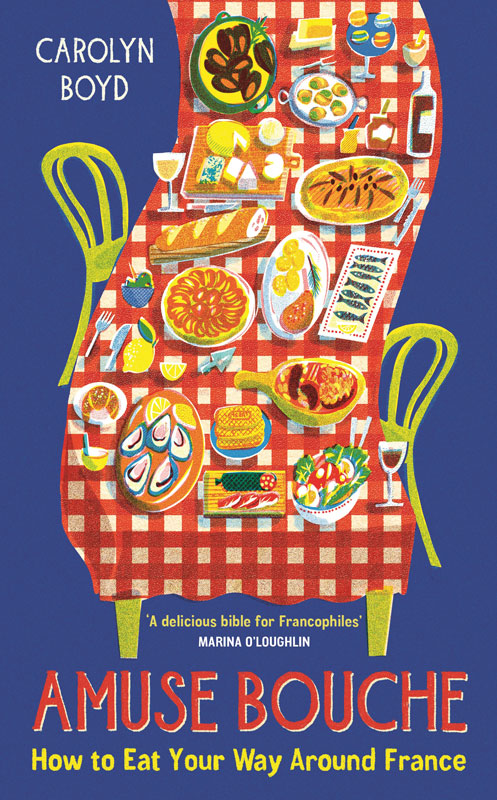
Amuse Bouche: How To Eat Your Way Around France (Profile Books) by Carolyn Boyd, is out now; €23.75, www.omahonys.ie.