



HOT TOPIC, LARGELY IGNORED: It’s time to talk about menopause in the workplace, says EMILY HOURICAN, who spoke to women about the impact of their symptoms on their working life …
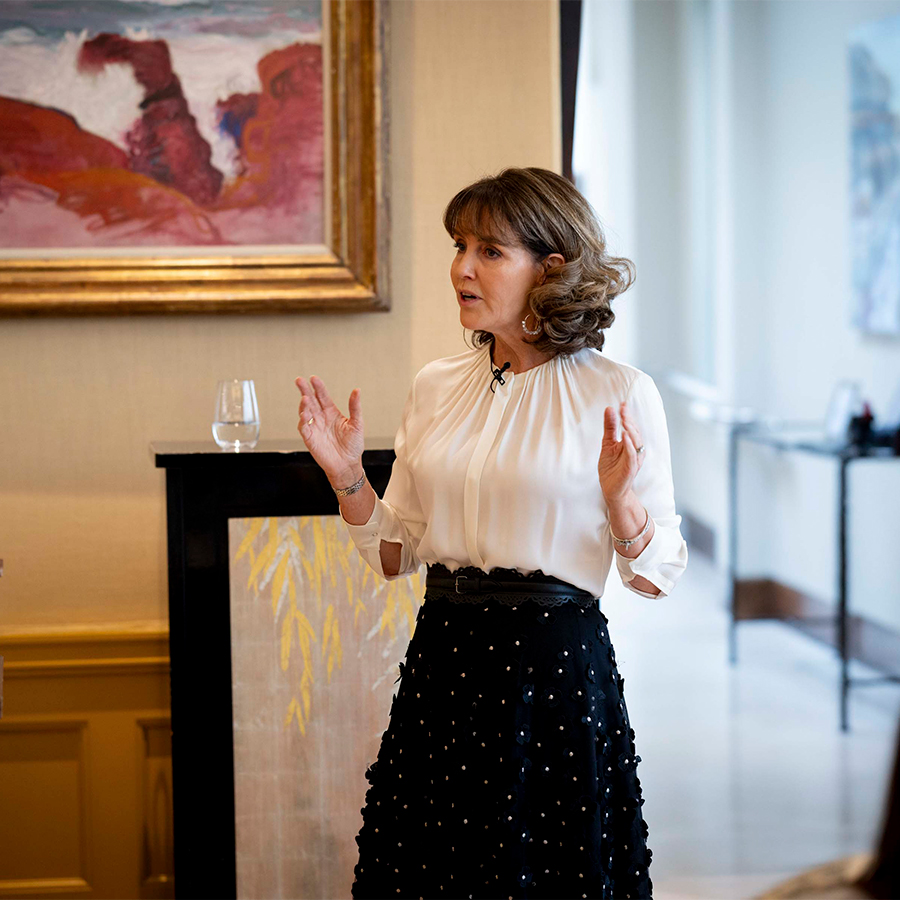
“Imagine the scenario,” says Loretta Dignam: “I’m a 50-year-old senior corporate professional making a presentation to a senior management team and mid-pitch, I have a hot flush. Unexpected and unwelcome. The heat rises from within – whoosh – and I’m sweating. I want to tear my jacket off, my face is gleaming with sweat and I’m trying to maintain my flow, my composure, my concentration.” This, she says, “is a real scene from my life, something that happened on many occasions over a period of three years. My confidence took a bashing. I didn’t speak up about being menopausal. Who would? The stigma, the embarrassment, the ridicule … how could I? I felt they would perceive me as an old, past-it, crazy lady.”
Along with the hot flushes, Dignam recalls, “lost words, memory lapses, poor concentration, insomnia, aches and pains, dry eyes, flat mood … the list goes on.” When she went looking for help, Loretta found such a lack of readily available services that she set up The Menopause Hub.
At least Dignam was well aware of what was happening to her – largely because her age, and the symptom of hot flushes were both classic indicators of menopause. For Sallyanne Brady, that was not the case. For her, menopause looked, initially, like an unconnected series of health issues that together added up to debilitation.
“In my mid-30s, I became an anxious person for no apparent reason,” she says. “It hit me like a ton of bricks. I wasn’t able to think clearly, had a constant feeling of being overwhelmed, to the point where I was unable to function on some days. I couldn’t make a cup of tea; I would sit down and cry. My GP prescribed anti-anxiety medication and anti-depressants. I didn’t think I was depressed, but I took them anyway. Nothing worked. Then, when I was 38, night sweats arrived. I went back to the GP. He said that was also caused by the anxiety. That carried on and then a few months later came insomnia; at one point I hadn’t slept for four days. I was almost hysterical. And still in all this time, no one said a word about hormones. I said to my GP, I think this is menopause, and he said ‘no, you’re too young’.”
From there, Brady developed tinnitus – “overnight, a high-pitched sound and a buzzing in my ears. I spent a year trying to sort that – seeing everyone from ENT consultants to my dentist. That was a living hell. Then I developed restless legs. At that stage I had so many things wrong with me, I didn’t know which doctor to go to. I was referred to a psychiatrist, and she said, ‘I wonder are you peri-menopausal?’ That was the first time I ever heard that word. I had been to A&E three or four times, I’d had a CT scan, a brain MRI. At last, in late 2008, I finally found a doctor who specialised in menopause. He said ‘you’re not mad, you need hormones’. He put me on HRT, and I knew immediately, this is what I needed. It took about seven months of tweaking the dose to get it right, but the improvement was consistent. Now, I don’t have a single one of those symptoms. But I lost four years of my life.”
Throughout this period, Brady was working as a sales manager. “It wasn’t a big corporation, and it was a flexible job, luckily. If it had been 9-5, I couldn’t have done it. I was on the road a lot, and there were days when I worked from home. Because of that, somehow I struggled on. Being flexible is what got me through. My boss was aware and he was understanding. If it hadn’t been for that, I couldn’t have continued.”
Because of her experiences, Brady set up a Facebook group, The Irish Menopause. “I hear from women all the time who give up work because menopause hits them,” she says. “When you consider the years of knowledge and experience they take with them, it’s so wrong and wasteful.”
It is also, until now, largely silent. These women leave the workplace, taking all their expertise with them, and they do so almost without a word, defeated by a combination of what’s happening within their bodies, and what isn’t happening around them in terms of support and understanding. Women don’t talk about menopause. We barely discuss it with our friends, let alone our employers. “Women should be able to go to Human Resources and say ‘this is how I feel’ but they worry that if they do, they will be discriminated against,” explains Brady. “There is already so much ageism in society; admitting you’re in menopause is like hanging a sign around your neck: ‘I’m old’.”
The usual stereotype of menopausal women is painful enough when applied in one’s home, but it’s far more damaging within a professional context.
The usual stereotype of menopausal women generally revolves around an image of a hot, flustered, emotional, forgetful middle-aged lady. This is painful enough when applied in one’s home and personal life – ‘oh, mum’s forgotten her keys/wallet/why she went upstairs again’ – but it’s far more damaging within a professional context.
Dismissing someone as “forgetful” might seem funny if they have spent minutes trying to recall “the name of that actor who was in that film with the other guy, you know…”, but it’s devastating if their role depends on them being seen as sharp and in command of every detail. Same with “emotional” – it’s one thing when said by a partner with whom you’ve just had a disproportionate row about the weekly shopping, but pernicious in the workplace where you are expected to take careful, far-sighted decisions.
A survey carried out in May 2018 by the Irish Congress of Trade Unions (ICTU), found that “women face real challenges in the workplace as a result of menopausal symptoms” and that “there was little or no support available to them”. These challenges were described as: “not being able to perform at usual levels due to tiredness caused by hormonal-induced insomnia to severe bleeding, pain, and discomfort”, and the report made the point that “If these symptoms were as a result of an illness or disease, measures would be put in place to support the worker, but because the menopause is seldom discussed and seen as just something that happens to women, the same considerations are not made”.
Of the nearly 2,500 respondents to the survey, 99 per cent said they didn’t have or didn’t know of a workplace menopause policy, and only 40 per cent said they would feel comfortable talking about the effect the menopause was having on them, and only in a confidential setting with either a line manager or a union rep.
There are currently 571,000 menopausal women in Ireland and 350,000 of those are in paid employment. That’s an awful lot of women, going through an awful lot of physical, psychological and emotional symptoms, without asking for help.
There is still such a dearth of information among women about menopause – including when it begins and how long it lasts – that, when asked for the most common symptoms, the majority will cite hot flushes and night sweats. And yes, these play a part but in fact, when asked what is the most common symptom women in menopause complain of in relation to their working lives, Dr Deirdre Forde, medical director of Ceile Medical and member of the British Menopause Society, says “without a doubt it’s anxiety. Women feel that perhaps they are not able to work anymore. They feel overwhelmed and insecure, and this spirals out of control in a downward trajectory. Many women do not actually realise that they could be in peri-menopause and therefore blame themselves as they have no one to talk to in the workplace.” And it’s not just women – GPs are under-trained in menopause, meaning they are likely to miss the bigger picture, and give out prescriptions for anti-depressants, anti-anxiety and sleeping pills.
Ask around and, after an initial moment of denial – “I feel fine!” – most women within the age bracket will admit to symptoms. Some talk about brain fog – being unable to think clearly. Others talk about an exaggerated sense of fear around being “found out”. For others, it’s mood.
“My work didn’t suffer,” says one woman who works in visual media, “but my relationships did. My mood was so terrible, for several years, that I alienated all my colleagues. I snapped at them and was unapproachable. Gradually, they stopped coming anywhere near me and I was isolated. I couldn’t see that my constantly low, angry mood had anything to do with my hormones. It was only when I started HRT and my mood improved dramatically, that I understood what had been going on. But,” she adds, “it’s too late. Those workplace relationships are too damaged to repair.”
BE THE CHANGE
The good news is that change is happening. In fact, we may be at a tipping point right now. Partly this is a natural evolution of inclusivity, and partly it’s because many of the 350,000 menopausal female employees are, by dint of age profile, now senior and C-suite managers. Meaning, they are now the decision-makers.
Loretta Dignam describes working with a number of organisations creating educational workshops for staff and for management in the last 18 months. “I have worked with the Irish Nurses and Midwives organisation (INMO) to create their position paper on Menopause in The Workplace. The issue is gaining traction with enlightened organisations who want to attract and retain quality staff. I firmly believe that menopause is where mental health was ten years ago, and where pregnancy at work was before that.”
Catherine O’Keeffe, (aka Wellness Warrior) menopause coach, agrees: “In the last twelve months I have seen some really progressive companies opening the door to the conversation.” These companies include Hewlett Packard Enterprise, Irish Life Health, Permanent TSB, Irish Cement, DLR County Council and the HSE. So what exactly does O’Keeffe do? “I educate the company, open the conversation. Train them to understand: What is menopause? What are the basic symptoms that will affect a woman’s working life? Menopause is an inevitable life stage – something every woman will go through. The average age of menopause is usually given as 50, but peri-menopause can start anywhere from the age of 40 or even younger. Given that we mostly work well into our 60s these days, that’s a possible 20 years of working life with or post menopause. The workplace has to open the conversation and that starts with executive level managers, Human Resources (HR), then line managers, and then employees.”
Menopause, she points out, “will be different for every woman. For one, Hormonal Replacement Theory (HRT) might be the answer, for another, it might be Cognitive Behavioural Therapy (CBT) and meditation. But, for all women – you’ve got to do the lifestyle changes: exercise, take supplements for the bone and brain heath, eat right, get proper sleep, and be informed about your options. Women tend to take the ostrich approach. That’s the worst thing to do. There are 34 known symptoms of menopause – you can’t ignore this. It impacts your life and your relationships, at home and at work.”
THE SCIENCE
Let’s look at the science. The symptoms most commonly viewed as problematic for work are poor concentration, tiredness, poor memory, feeling low/depressed and lowered confidence. So how much truth is there to the menopausal stereotype of the forgetful, flustered, indecisive middle-aged woman?
Dr Caoimhe Hartly, GP at the Menopause Hub and accredited menopause specialist, explains: “We all have estrogen receptors throughout our brain. Estrogen seems to stimulate neurons in our brain and influences how they communicate with each other. It also may influence the health/survival of these neurons and how well they function or do their job. In peri-menopause/menopause, we lose this vital estrogen and ‘brain fog’ is an extremely common symptom reported by menopausal women. There have been longitudinal studies of menopausal women not on HRT, showing small decreases in fluency, verbal and episodic memory, attention and ‘executive function’.” Dr Hartly points out that symptoms, particularly regarding verbal memory, are often worse in women who have had “medical” menopause – due to surgery or medication – and those who have menopause under 49.
Dr Hartley cites a “cross-sectional study of over 200 men and women (aged 45-66), in their late reproductive/ peri-menopausal years which demonstrated that women of that age outperformed men in detailed memory tasks. This superior performance declined as women became menopausal. So when their serum [blood] estrogen levels were higher, their performance in memory tests was better. I would argue that what happens with menopause, to some women, is that we fall to the same level, in terms of cognitive function as men. We just started off at a higher performance level.”
These findings suggest – and this is vital! – that “the principal barrier to women’s performance in the workplace is not their cognitive decline or ‘brain fog’, which has been demonstrated to be extremely small. Women will often adopt strategies to cope with symptoms in order to have no disruption to their performance at work. What affects women more is the stress of having to make those adaptations in silence, unsupported: the stress of constantly trying to conceal their menopausal status at work due to fears of being stereotyped, discriminated against, perceived differently.”
Clearly, it is time to start talking about menopause and work. Let’s give the last word to Ruth Bader Ginsberg, whose vital working life continued until she died recently aged 87: “real change, enduring change, happens one step at a time.”








LOVETHEGLOSS.IE?
Sign up to our MAILING LIST now for a roundup of the latest fashion, beauty, interiors and entertaining news from THE GLOSS MAGAZINE’s daily dispatches.