

How restaurateur Kevin McMahon took on the renovation and extension of a Victorian house in south Dublin …
“It could be very tough to be in an apartment right now, without a garden or outdoor space – we genuinely feel very blessed.” Kevin McMahon, owner of the Wild Goose Grill in Ranelagh in Dublin, speaking to us from his home, is very grateful to have a spacious house and garden during lockdown for himself and his wife and three children. Like all of us, he’s been spending a great deal of time at home. In his case, keen as he was to get back to work, it has not been an altogether unpleasant experience, given the beautiful home in which he lives.
But this week, he is very pleased to be back at work, having just launched a takeaway service – Goose 2 Go. The elegant Wild Goose dining room over McSorley’s pub may be closed but now his team is preparing a somewhat reduced but delicious range of dishes, from steak and a bottle of wine, to tasty tapas boards, which clients can order by phone and call to collect or have delivered. It will be a while before his loyal clientele can return – “we are working on providing a safe environment for when we can re-open” – but when they do, around the end of June, it will be with real enthusiasm, appreciating as they do how Kevin has carved out a niche for sophisticated, comfortable dining in a very pretty setting. “We will scale down to half our usual capacity, with people spaced at a safe distance, in small groups.”
Back to the Story of Home. In 2008, Kevin and his wife Mema, having sold their house in Sandymount, began renting a Victorian house on Anglesea Road, still in Dublin 4. Five years later, in 2013, the owner decided to sell, and with the price of the house now within their reach, Kevin and Mema were thrilled to finally call the house home.
In February 2008, Kevin had also signed the lease on a restaurant in Ranelagh. With three children, including a baby son born in late 2007, it was an incredibly busy time. A new rented home, a new restaurant, a new baby – and then, a broken leg. It felt like the perfect storm. (There was worse to come, with a recession on the way at the end of 2008 – but that’s another story). “It was an extraordinary time,” says Kevin, “incredibly stressful … we put a huge amount of energy into opening the restaurant, and it was the usual mad dash at the end.”
Buying the house in 2013 was another stretch for resources and energy. “We used all our money to buy it, including what my mum had left me when she died. We had no extra money to do it up. Luckily both Mema and I came from old houses, so we appreciated the house’s character and overlooked its shabbiness, even if it was very cold in winter. It had a long garden with the River Dodder at the end of it, with Herbert Park just beyond that and was close to town and lots of amenities.”
The family geared up and saved up to undertake an extension and restoration, but it was 2018 when they finally embarked on the renovation and extension with Robert Bourke of Robert Bourke Architects (an award-winning architectural practice based in Dublin which aims to create people-centred spaces) a full ten years after they had started living in the house. “We certainly had had plenty of time to consider what we wanted.” Having operated out of a narrow galley kitchen – “grim”, in Kevin’s words – for a decade, a place to cook, eat and gather family and friends was top of the list. “We entertain a lot, and the space was not working,” says Kevin. An open-plan kitchen / dining area to accommodate a gang was a priority. The couple had had plans from two other architectural practices but Kevin explains, “Robert Bourke just spoke our language – he knew what we wanted – a bright, light space.” Robert was up for the challenge even though, as he says, “designing a kitchen for a restaurateur was something that would involve intense discussion between client and architect.”
The kitchen was just one issue. The building was dark, damp and cold on all but the finest of summer days. The house had been split into two separate units and Kevin and Mema had prioritised the stripping out of ad hoc partitions to return the house to its original layout. However, the house remained inhospitable and poorly connected to the back garden. The initial concern was that the renovation work would absorb the entire budget, leaving insufficient funds for the extension. Therefore, the work had to be strategic and the extension as efficient as possible in its layout and construction.
The renovation work was limited to some simple internal alternations: re-wiring, a new gas heating system with properly sized radiators and thorough insulation of the attic room. The insulation of the external walls would have been difficult and prohibitively expensive as external insulation would have covered original brick features and internal insulation would have involved the removal of ornate plasterwork. Although it is not a protected structure, both architect and owner were keen to preserve as many original features as possible. Windows replaced with double glazing while maintaining their historical integrity cost a small fortune but transformed the front of the house and improved heat loss and sound-proofing.
The site was a tricky one. Anglesea Road follows the sinuous line of the Dodder River for a stretch before bending off course. The back garden meets the river where this change in direction occurs, creating an unusual bend in the garden. The architects worked hard to find a geometry for the extension that mediated between the different angles of the house and garden.
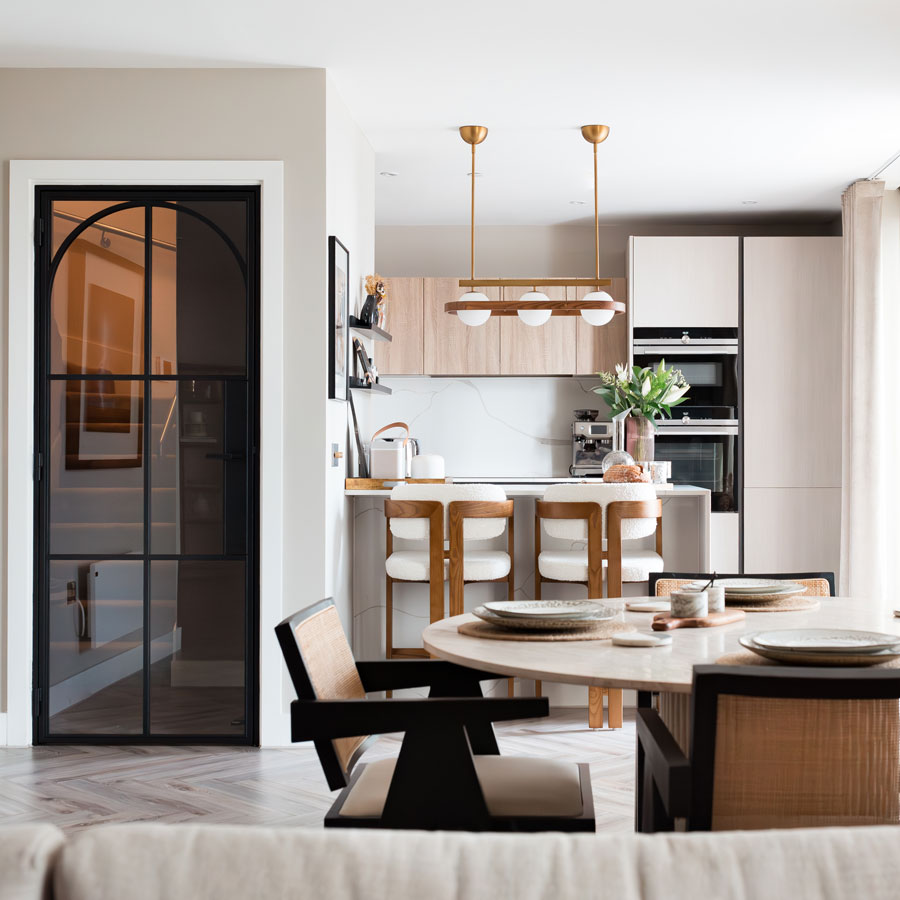
The brief for the extension was to accommodate spaces for a kitchen, dining area, utility room and coat storage as there was no cloakroom in the original house. The final design comprises a series of carefully positioned walls and glass screens which follow the changing angles of the site. Simply put, the dining room follows the lines of the house and the kitchen follows the lines of the garden. The utility room, accessed from the kitchen via a secret door, helps to subdivide the space into zones for coat storage, dining and cooking. The subtle shift in direction can be read in the angles of the white painted timber roof joists over the dining and kitchen areas.
The structural steelwork, designed by engineer Denis Kelly, was carefully concealed. As a result, the immense weight of the first floor of the return is suspended with no visible support. The temporary propping and construction work was skilfully executed by builder, Tom Nolan of Nolan Construction. A large, triple-glazed rooflight fills the space in between the dining and kitchen zones and affords a glimpse of a tree in the neighbour’s garden. The reveal of the rooflight is lined in oiled birch plywood. This brings constantly changing light and an unusual warmth to the space.
A change in ceiling height between the spaces creates a sense of drama when moving from the lower dining area – at the original ceiling height of the return – and the three metre-high kitchen which sits in front of the return.
Designing a chef’s kitchen took some real thought. The aim was to find a contemporary layout and style while acknowledging the Victorian heritage of the house. The cupboard doors have simple framed edges with robust brass handles. The colour chosen is a dark green which connects with the lush green planting in the courtyard and back garden. Kevin’s pride and joy – the bright yellow Lacanche range – is the focal point. “Having cooked for years on an old electric hob, this is like driving a nice car when you are used to driving a banger!” Large sliding folding aluminium doors allow the back wall to open fully to the west-facing back garden. The floor is laid with a large format light grey ceramic tile with underfloor heating.
A large coat cupboard forms one wall of the lobby as you enter the extension from the hallway of the original house. Full-height mirrored doors with discreet metal handles reflect the courtyard on the opposite side, creating the illusion of a much larger space.
The master bedroom was moved to the front of the house to take advantage of its eastern orientation for morning sunlight. A large wardrobe, forming a wall to a new en suite bathroom, was clad with a distinctive wallpaper print chosen by Kevin and Mema. Joiner Shane Duffley made the kitchen and all the fitted furniture. The attic room, the domain of their eldest child, was fully insulated and clad with painted tongued and grooved cladding. The cladding wraps around the room and into the alcove formed by the low dormer window on the gable of the front façade.
Outside, much space was left for planting, the architects creating a simple, asymmetric form which allows the shifting geometry to read clearly. The painted rendered walls of the extension relate to the existing house and provide ample surfaces for climbing planting, which will cover the new structure over time.
Robert Bourke Architects www.rba.ie
Photographed by Ste Murray
GOOSE 2 GO: order by phone 01 4912 377; Thurs-Sunday from 1pm. Collection and delivery 5-9pm Thurs/Fri/Sat and Sunday Lunch 1-7pm. All wines on the wine list available at 4O per cent discount. www.thewildgoosegrill.ie; No.1 Sandford Road, Ranelagh, Dublin 6 ; 01 491 2377

The simple, asymmetric form of the extension allows the shifting geometry to read clearly.
The subtle shift in direction can be read in the angles of the white painted timber roof joists over the dining and kitchen areas.


The high–ceilinged kitchen contrasts with the more intimate dining space.

The reveal of the rooflight lined with oiled birch plywood.

When viewed from the courtyard, the original first floor return of the house appears suspended over the new extension.

The utility room, concealed behind a secret door, subdivides the space into separate zones for coat storage, dining and cooking.
Sliding-folding doors fully open to the west facing patio.


The mirrored coat cupboard reflects views of the lush courtyard.

The wardrobe in the master bedroom with wallpaper print.

Kevin’s study in the rear reception room of the original house with an old door to a new courtyard created by the extension.

The shifting angles of the extension can be seen from the balcony of the attic bedroom with views to Hebert Park on the opposite bank of the River Dodder.

Tongued and grooved lining in the attic bedroom.






LOVETHEGLOSS.IE?
Sign up to our MAILING LIST now for a roundup of the latest fashion, beauty, interiors and entertaining news from THE GLOSS MAGAZINE’s daily dispatches.