


Irish artist Sharon Murphy draws on theatre, magic realism and theatre for her new exhibition at Golden Thread Gallery, Belfast
Who or what kickstarted your interest in art?
I came to art through theatre. I worked as an actor and later in theatre education with various theatre companies including the Abbey Theatre. The early immersion in dramatic space (the stage, the rehearsal room, scenography, and the imaginative world between text and performance) shaped the foundations of my practice. I was drawn to the sheer humanity of theatre, to its vast range: madness, grief, violence, love, tenderness. To the full complexity of human interaction played out through bodies in space and, through the charged presence of the audience. All of life is possible there.
Peter Brook’s idea that theatre begins with an empty space, someone crossing it, and someone watching has always stayed with me. It speaks to presence, attention, temporality and the possibility of transformation. What compels me is the dynamism of that moment: the live interaction of body, space and viewer. This is the essence of mise en scène.
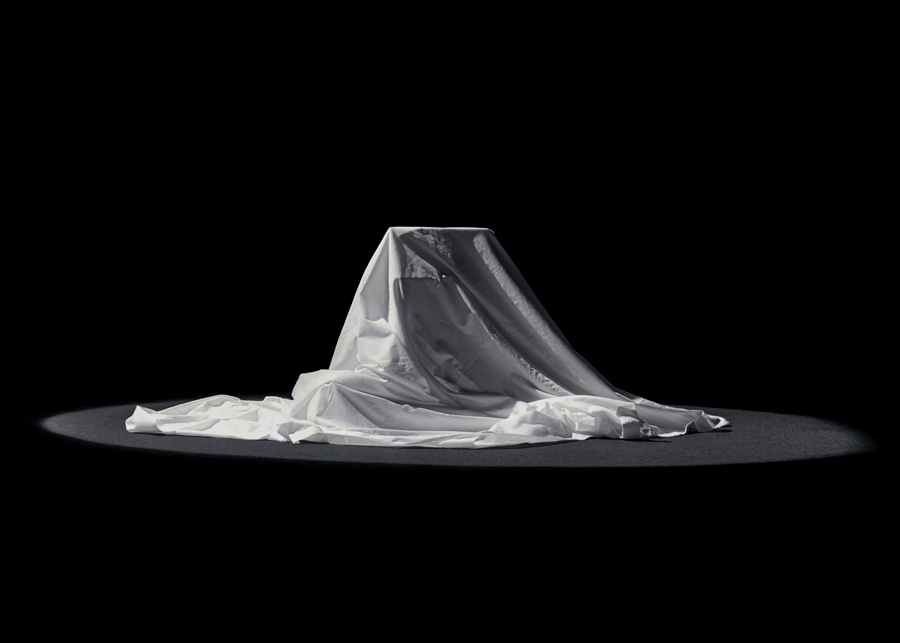
Photography arrived later, formally at least, though it had been present since childhood. I spent time as a teenager in my uncle’s photography studio and darkroom, absorbing the quiet discipline and material magic of the process. When I eventually turned to photography as an artistic practice, it felt like a natural extension of the sensibility I had carried through theatre: a fascination with what can and can’t be seen, with atmosphere, interiority, and the suspended moment and that charged space between veracity and illusion. As in theatre, mise en scène is central: the work begins with the arrangement of elements; the relationship between the subject and the space around it, and how the viewer is invited in.

How do you describe your photography?
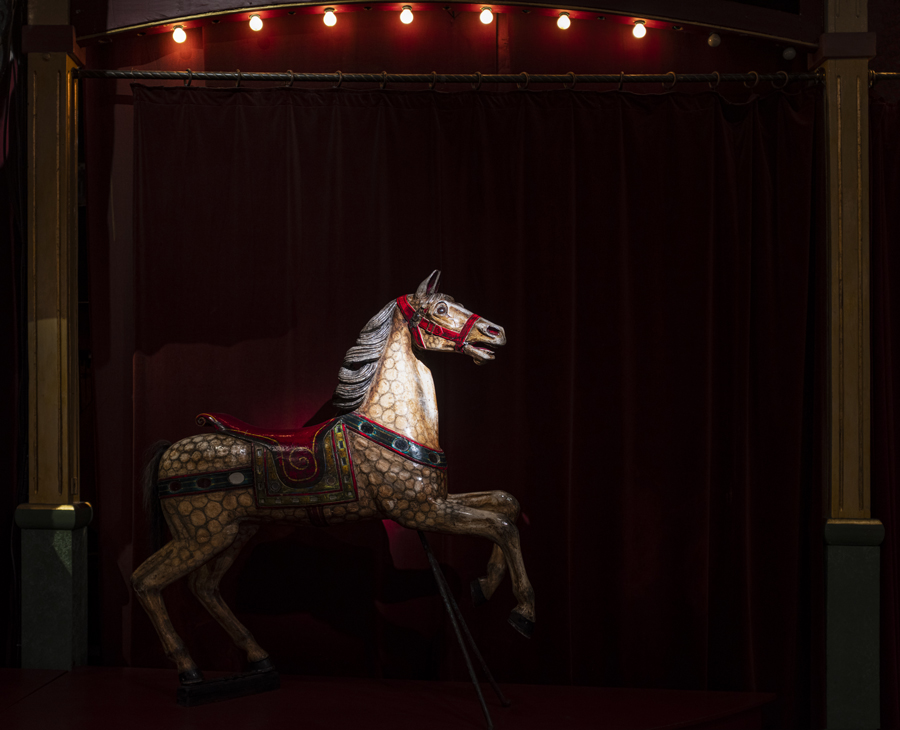
My photography is shaped by a theatrical sensibility and by an interest in the psychological and the uncanny. I conceive of space as staged. I draw from theatre, psychoanalysis and magic realism, working in spaces that already carry their own atmospheres, such as stages, rehearsal rooms, fairground architectures, transitional environments. I’m drawn to curtains, veils, coverings, thresholds, and partial views: places where something seems about to reveal itself, or remain withheld.
I look for images that hold a slightly disquieting stillness. They play with the tension between what looks real and what feels real, echoing that moment when the familiar becomes strange. The viewer is implicated: the act of looking becomes part of the image. Increasingly, I’m interested in the sculptural qualities of the photographic surface, and in constructing layered visual narratives that feel both tangible and metaphorical. Real and imagined spaces fold into each other, offering a glimpse, a fissure, a portal: a scene paused on the edge of recognition.
How and where do you work?
I work between Dublin and Paris. These two locations create a natural rhythm in my practice: Dublin offers continuity and reflection; Paris offers immersion in the spaces and atmospheres that have become central to my recent work. I love working in cafés too – writing, and reading (mainly autofiction).
The studio in Dublin is where I write, research, reflect, edit and plan. It’s a room of my own where ideas can form and I can stick images and texts on white walls. The images themselves are made on location. I spend long periods in theatres, rehearsal rooms, outdoor staged spaces and most recently in in Parisian parks, responding directly to their atmospheres and their implicit sense of performance.
Paris has been central to this process. I developed and first presented Mise en Abyme there, working with Parisian carousels and theatrical structures. They’re both spaces that hold simultaneously fantasy and melancholy, surface and secret. It allowed me to explore staged stillness, illusion and the uncanny. I like working with curators in a slow, developmental way, allowing the work to unfold through conversation, time and careful attention to place. Each iteration of Mise en Abyme has been shaped by the curators (Nora Hickey M’Schilli, Centre Culturel Irlandais, Trish Lambe and Darren Campion, Photo Museum Ireland, and Sarah McAvera, Golden Thread Gallery) and has altered, shifted and expanded due to the specifics of the sites.
Your work is inspired by theatre, magic realism and psychoanalysis – how have these themes evolved over time?
They have evolved as parallel languages that eventually converged. Theatre gave me an understanding of presence, staging and the charged emptiness of a paused moment. Magic realism allows the improbable or the uncanny to sit quietly within the everyday. Psychoanalysis, particularly ideas around memory, doubling, and the instability of perception, shaped my interest in the gap between what is seen and what is sensed.
Over time, these threads intertwined. What began as an interest in theatrical stillness grew into a deeper enquiry into the fictive real: the way photography can operate as both documentation and misdirection. It is both indexical and constructed., like our family albums. My work now explores the slight fractures between perception and reality, truth and falsehood, concealment and revelation. I think of each image as a proposition: an invitation to step into a space where illusion and reality intermingle, and where the viewer’s own associations animate what lies behind or before the curtain.
Need to Know: Sharon’s exhibition Mise en Abyme runs until January 31 at Golden Thread Gallery, 23-29 Queen Street, Belfast, Co Antrim; www.goldenthreadgallery.co.uk. @sharon_murphy_atelier.
SEE MORE: Artistic License: Geraldine O’Neill