Artistic Licence: Elva Mulchrone
By The Gloss
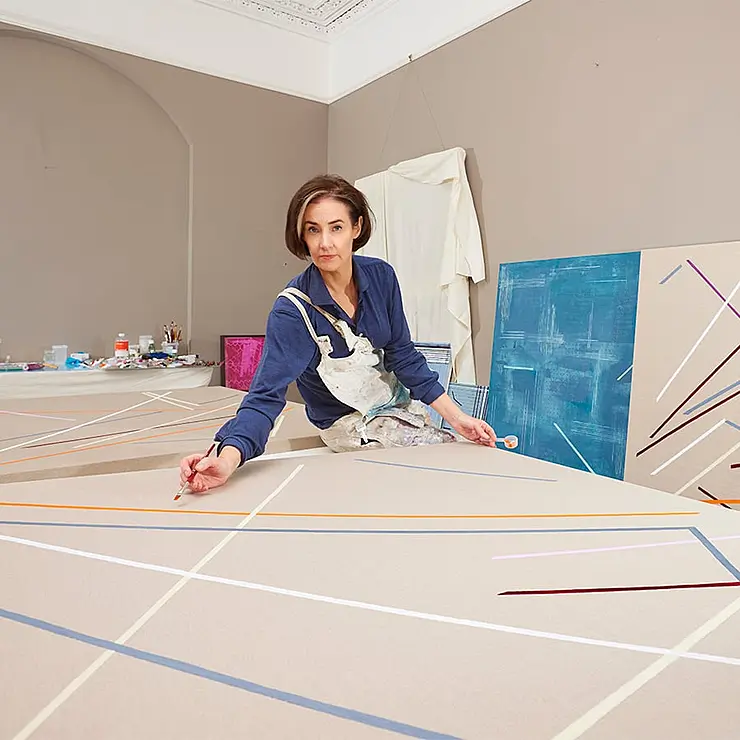
Elva Mulchrone’s latest work draws on her time in New York and is reflective of grid systems, symbolising the distribution of power and control …
How did your artistic journey begin? I don’t really remember the moment when my interest in art began – it was just always there. My father was a clothes designer and manufacturer, so I grew up surrounded by sketches, buttons and thread. Someone put paper and pencils in front of me when I was very young, so I just drew. Really, my childhood was mostly drawing and reading. I wasn’t sporty and I had no real interest in television.
Who are your mentors and muses? I must say, I’ve been very lucky with mentors. A few people stand out. Helena, my art teacher in first year, was one of the first. She entered my work in a competition in the National Gallery and it was accepted. I remember standing there with my mother while the Director Raymond Keaveney spoke about my work. I was very shy and didn’t quite know what to make of it, but it stuck with me.
Robert Armstrong, my final year tutor at NCAD, was a major influence. In a different way, Philip Lane and his wife Órla – friends from Trinity – were also hugely encouraging. After NCAD, I completed an MA in Painting at the Royal College of Art in London, where Alexandria Smith and my tutor John Strutton were important mentors. Mick O’Dea, then Head of the Painting School at the RHA, was another key influence. I bumped into him shortly after stepping back from legal practice at William Fry and he invited me to a life drawing group the following week. I went – though he later said he didn’t think I would – and I loved it.
My brother Martin – who passed away in 2023 – was hugely important. He was my best friend and one of my biggest supporters. He loved what I painted and encouraged me constantly, even while I was working as a solicitor, and he collected my work.
As for muses, they’re less traditional. I’m drawn to the subjects behind the data: the people affected by the decisions of policymakers. Through projects in cities like London, New York and Berlin, working with children, communities and academics, it’s really their stories – their lived experiences – that inspire me. It’s the human side of information that continues to drive the work.
What made you change careers and what advice would you give to others in a similar position? I made the change because, in truth, I always wanted and needed to do this – I just didn’t have the courage to pursue it when I finished at Trinity at 22-years-old. At the time, art felt like a very alien world. My advice to others is to be clear as to why you’re doing it and be honest with yourself about your expectations. Be true to yourself.
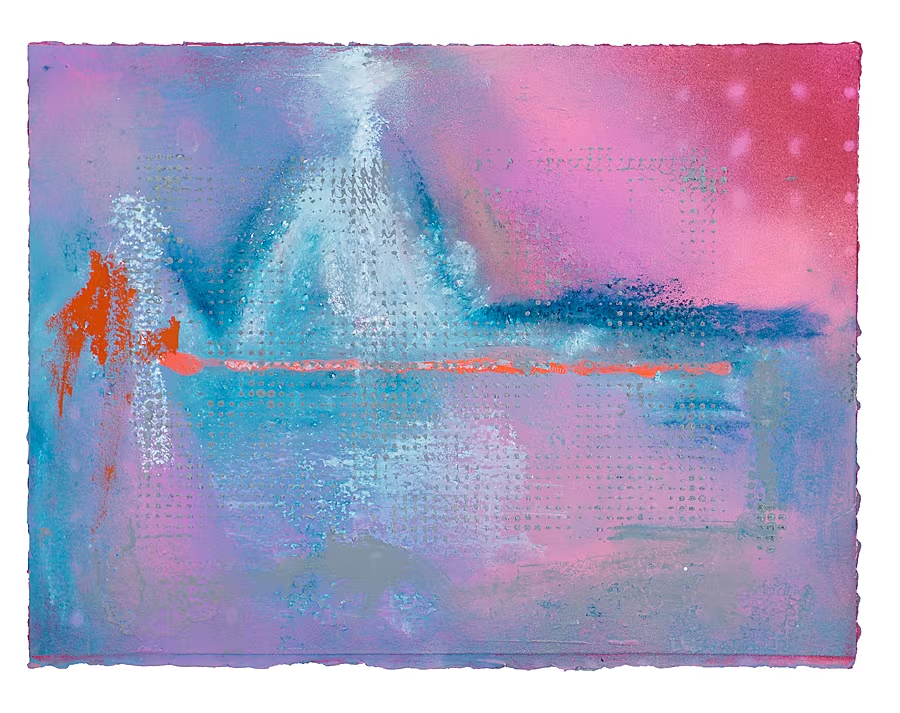
Where do you work? I work wherever I am! It’s constantly with you – in my head or a notebook. In practical terms, I mostly work from home between a studio space and the kitchen table, but I’ve also been fortunate to work in a range of studios in recent years – in New York (through the Fulbright programme at the Elizabeth Foundation), at DCU as Artist in Residence (2023/24), in London at Queen Alexandra’s House and the Royal College of Art, and in Singapore and Berlin at UdK. Ultimately, I adapt to whatever space I’m in. The work tends to be smaller and on paper in more confined settings, and larger in institutional ones.
My work is inspired by research, often in economics and the social sciences, where I’m directly involved. But I depart from it – in a world where information is not trusted, I suppose, I reduce the research along with my own responses – into abstraction, primarily through painting.
I take a huge number of photos and they also inform the paintings, but once I start it’s really an instinctive process and pieces take their own course.
Tell us about your latest exhibition, The Grid? The starting point for my new exhibition was the research done by Professor Maeve O’Brien in DCU. Her work, which uses a spatial metaphor to represent women’s voices on their invisible care work, influenced me to reflect on mappings and systems of inequality. Her work and my project at DCU led me to a Fulbright scholarship with research at the Graduate Center, CUNY in New York, focusing on social science perspectives on inequality. Previously, I’ve been consumed by inequality in income patterns/economics, but in a social science context it’s about stories. These were stories about women and children, but more broadly people and social mobility.
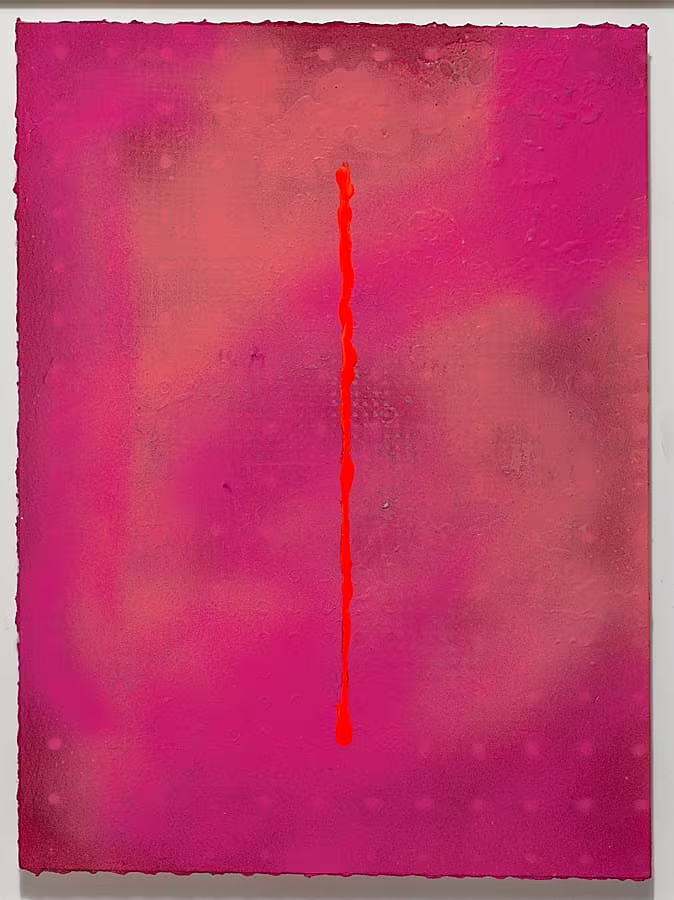
What’s the symbolism of The Grid in your work? It has multiple symbolisms for me, including personal ones. Living in New York, I found the grid system quite extraordinary, both visually and for ease of navigation. Through research I was involved in, I became fascinated by the role it plays in facilitating control, such as controlling the streets by the NYPD and the use of surveillance. I was involved in participatory research groups, including the Public Science Project, Participatory Action Research and Art Science Connects, all of which explore issues of control, human dignity and inequality as outcomes of systemic policy. I found that experience quite overwhelming.
The grid is a framework of bars, but actually it’s a system for distributing power: the metaphor for control and data usage is intrinsic in the work. It’s about connecting, but also disconnecting from oneself – one’s tribe, expectations, class. It speaks of inequality not just between groups, but within them.
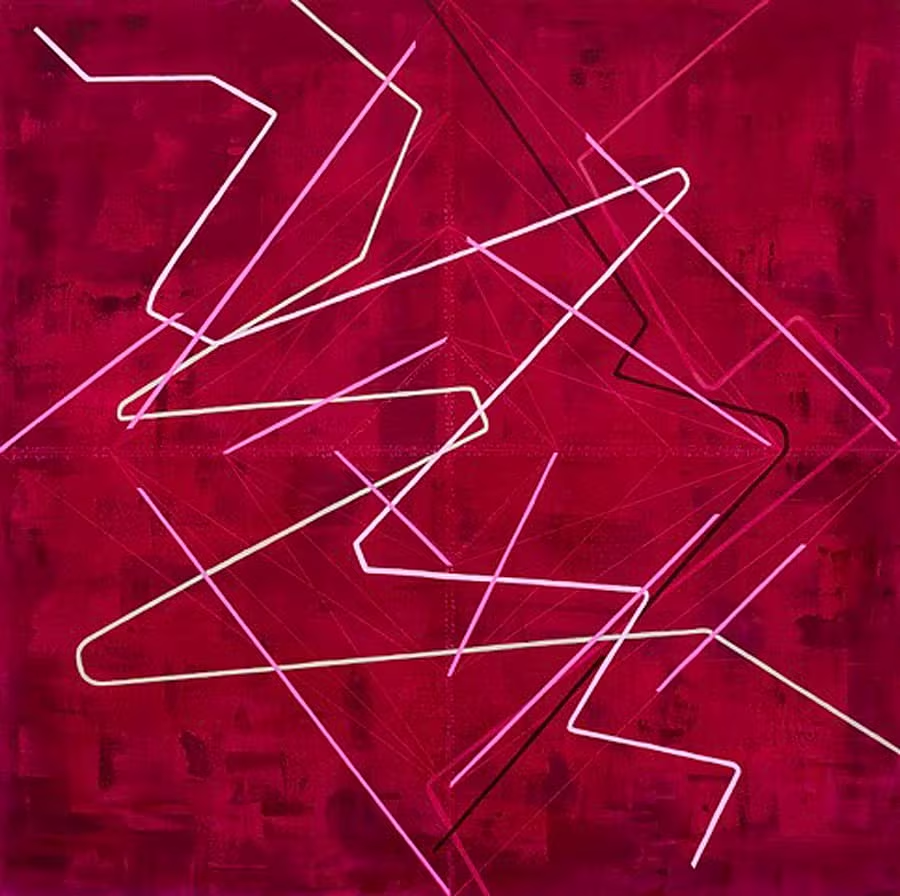
What do you hope visitors take away from viewing your work? I hope they feel something, that the work evokes or triggers an emotion or a thought. Perhaps it might prompt questions about what it means to exist within the grid, within systems – not just online in a literal sense – but as a broader metaphor for how we live. I don’t have any answers, my work is about questions.
Need to know: Elva Mulchrone’s exhibition “The Grid” is at The Lab Dublin from April 16 to May 23. @elvamulchrone