Put On A Show: Acting To Find Your Voice
By The Gloss
Conor Horgan took a dramatic route to overcome his shyness and find his voice: all he had to do was make a complete show of himself …
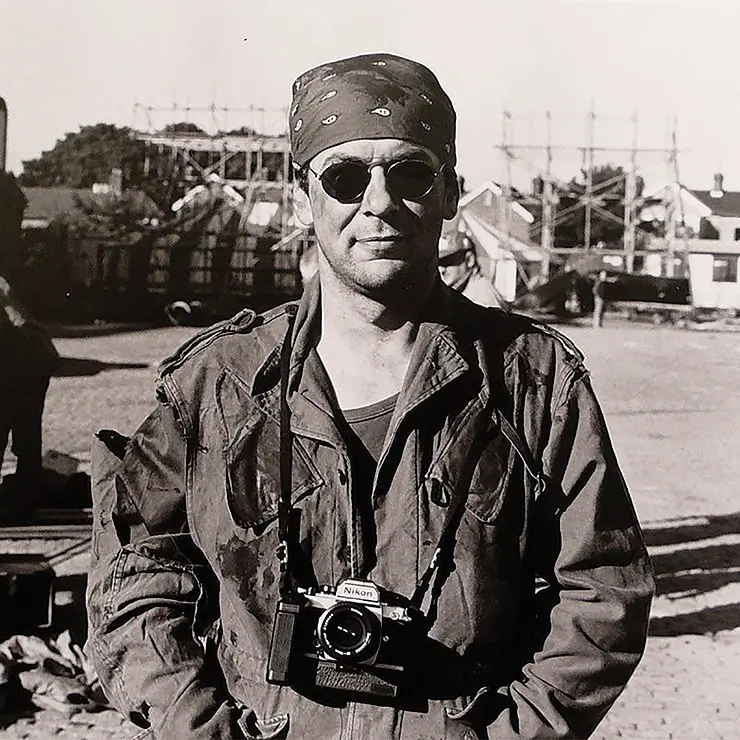
Conor in a test commercial for Chanel, directed by John Moore, on the set of Michael Collins at Grangegorman. Conor played the part of a war photographer during the Vietnam War.
We live in a world where a degree of public performance seems to have become a necessity for getting on in life, which for the introverts and shy people among us makes life all that more challenging. If there is a sliding scale of brazenness, I’d be a lot closer to the Howard Hughes end than to someone like current US Homeland Security Secretary Kristi Noem, whose cosplaying as a heavily armed, flak-jacketed security agent with a full set of hair extensions has had her nicknamed ICE Barbie. And even though these days I can usually acquit myself fairly well when called on to speak in public, every time I manage to pull it off, I’m still quietly surprised.
First Act
It was not always thus. I was a serious, withdrawn kid, and it wasn’t so much that I was afraid of public speaking, which I was – I was afraid of private speaking. Some of this stems from my very first attempt at speaking in public, a complete and unmitigated disaster. It was many years ago but the memory is still sharp, and I remember acutely how I felt afterwards. I’d been chosen to do a reading at my Confirmation, in front of all my family, schoolmates and the Archbishop of Dublin. I stood at the lectern, quaking gently as I waited on a hair-trigger for my cue. When one of the roadie priests whispered was I ready I launched straight into it. My voice echoed around the huge church, and my relief as I neared the end was overshadowed by the sense that something had gone very wrong. I glanced over at the Archbishop, to find him looking daggers at me over his glasses – it seems I’d stepped on his lines, as nobody is supposed to speak before the star of the show. I felt very ashamed, a feeling that persisted for the longest time. Years later I discovered that many people are more afraid of public speaking than they are of death – that made a lot of sense to me.
A Suit of Armour
As I entered my teenage years the terror of blowing my cool got even worse. I was surprised years later to hear from an old schoolfriend that my habitual silence had been taken as intimidating by some classmates – they assumed I didn’t deign to speak to them, when the reality was, I couldn’t think of anything to say. Help came from an unexpected quarter – a Saturday job at the Lambert Puppet Theatre in Monkstown. The two youngest Lamberts were my friends, and before long I was spending as much time as I could in their house – there were so many kids around I don’t think anyone noticed an extra one. Not being of Lambert blood made me like a non-Italian member of the Mafia – I didn’t get to go near the puppets so was put to work selling tickets, manning the sweetshop and helping to clean up afterwards. Then we’d all have our tea and watch that week’s episode of the children’s television programme Wanderly Wagon, starring head of the family Eugene as the bumbling O’Brien. He could be a hard taskmaster to his homegrown theatre company, and there were times when some of the older brothers only spoke to him while in character as one of the puppets. On Sundays we’d go in to RTÉ to shoot next week’s episode, and one glorious day the rules were relaxed and I got to play the squirrels in the window-box – no lines, just squeaks, but still a big moment for me. I don’t know if this was one of the episodes written by starting-out screenwriter Neil Jordan, but as the Forty Coats character wasn’t wrestling with his sense of identity or exploring a taboo relationship, probably not.
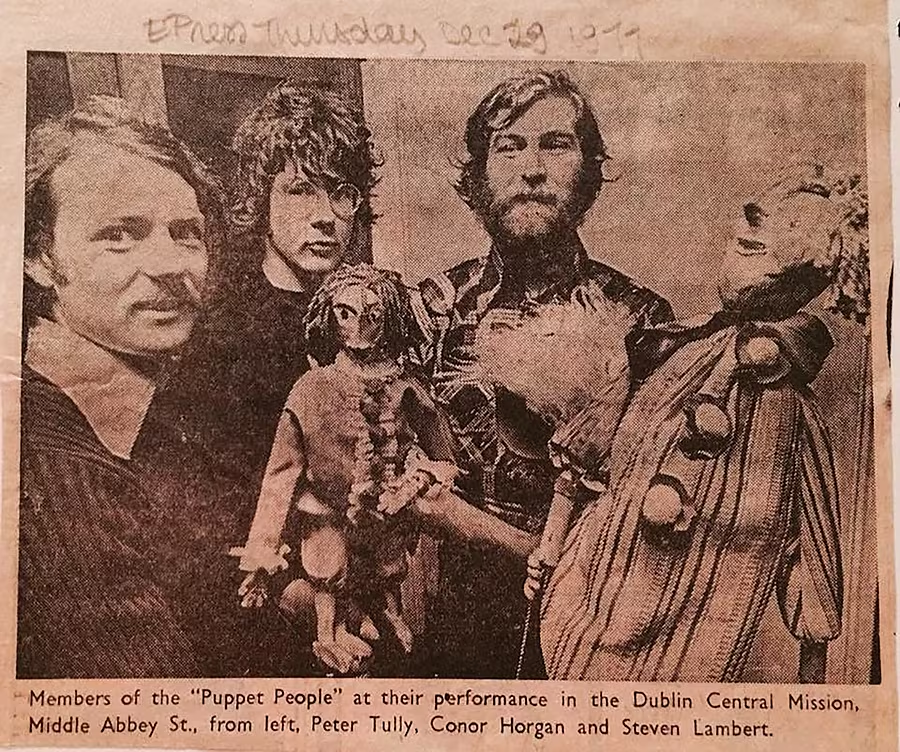
Conor, middle, photographed at a Puppet People performance in Dublin, 1977.
Shortly after I turned 15, youngest Lambert daughter Paula had had enough of working for Eugene and decided to set up her own puppet company. To my great surprise the first person she called was me. Though I’d never thought I could be a performer, she saw something in me and that was good enough.
We were called Puppet People, and it felt like we were the Provisional Lamberts to Eugene’s Officials – I also knew that by throwing my lot in with her I could never go back to Monkstown. By then my voice had broken into a deep baritone so I played all the villains, including the memorably named Terrible Turkey. We toured all over the country, playing to thousands of people at Feis Ceoils, and had a successful run of shows in the Project Arts Centre. Even though I was utterly mortified every time Paula called us out from behind the wooden booth to take a bow, in doing the show I’d made a discovery that helped me get over some of my horrendous self-consciousness.
I know now that many performers, especially drag artists, see their costumes as a kind of suit of armour and I’d found my version of that – it turns out that you can do pretty much anything, even singing and dancing, from behind a quarter-inch of plywood. I’d have been absolutely fine out in the world, if only I could have figured out how to bring my suit of armour everywhere with me.
By the time I hit my 20s I was ever-so-slightly less silent, though still nowhere near chatty. An obsession with photography had won me an apprenticeship with Tony Higgins, the leading fashion photographer of the day, and I quickly found out that to get good pictures of people you needed to talk to them. This was quite a challenge, so when I started doing headshots as nixers all I could do was copy Tony’s practised patter word-for- word. Eventually I started to develop my own and made the happy discovery that rather than being something to hide behind, a camera could be a way of connecting with people.
I also discovered why it is that so many actors are actually shy – it feels liberating being someone else for a little while.
Naked Public Vulnerability
Thoughts of performing again didn’t even cross my mind until many years after that, when I started directing TV ads and pretty quickly had to face the fact I had no idea how to talk to actors. Well, I knew how to talk to them but not how to stop, and I got used to seeing their panicked eyes registering “Full” when I was barely halfway through giving an incredibly detailed, fundamentally unplayable set of directions. So nothing else would do – I took myself off to some acting classes. The first thing I discovered was that every class was specifically designed for the students to make the biggest fools as possible out of ourselves – not very welcome for someone who still took themselves as seriously as I did. Nevertheless I pushed myself on, writhing around on the classroom floor pretending to be a tree in a storm, but I wasn’t enjoying any of it. Then during subsequent courses I made some interesting discoveries – one, that I was actually kind of okay at acting and two, going out of my way to make a complete eejit of myself was actually quite good for me. Well, at least it helped me take myself a lot less seriously, which could only be a good thing. It turns out that being kind of okay at acting was enough to get me cast in a couple of bit parts, and I also discovered why it is that so many actors are actually shy – it feels liberating being someone else for a little while, and as an extra bonus you get to shout at, fight or kiss people, all with no consequences whatsoever.
Just Say No
It’s said that the only power an actor has is the power to say no, usually to parts they’re not suited to. I wouldn’t know, having said yes to every single thing I was ever asked to do – these included a stern-faced martial arts instructor, a stern-voiced neglectful father, and two completely different stern-faced patients in The Clinic TV series. They were different not only because one was called Angry Patient and the other Impatient Patient, by using all my skills of characterisation I’d given one of them a beard. To be fair, I’m not a particularly stern person, but the combination of the deep voice and decades of squinting through cameras have given me the appearance of a habitual scowler, and you might as well use what you’ve got. Not only did I never turn down a role, I’m very proud of my 100 per cent success rate at auditions. To be clear this comes from the one and only audition I ever did, which got me the part of a (you’ve guessed it) stern-faced paterfamilias in an am-dram production of an Alan Ayckbourn play. I may never do another audition, not least because the chances of immediately reducing my hit rate to 50 per cent is very high indeed.
I’ve acted in a movie shot in Hollywood (Co Wicklow).
Working on the play was a delight, though the six-month rehearsal period in the back room of a Rathmines pub made me think we were never going to actually offer it to an adoring public. This meant I didn’t take it seriously enough to even begin to learn the lines, so when the production date was set, I had a mad scramble to get off book, and though I didn’t dry once on stage I had stress dreams of doing so for years afterwards. Not being overburdened with confidence in either myself or the production, I didn’t tell anyone I was in a play until after we’d performed it for the first two nights of our week-long run. So all my nearest and dearest came to see it on the fourth night, which is when things came seriously unstuck.
The play was set in a restaurant, with scenes that went back and forth across a timeline of several years. Most of my scenes were with my wife, and as we headed towards the interval I realised with horror that she’d jumped from halfway through the scene we were in to another scene that was supposed to happen much later, the one in which I’m just about to find out she’s been sleeping with my brother. The sense of being on a runaway train was overwhelming, and thankfully the lighting operator hadn’t fallen asleep and brought the lights down just as we ran out of dialogue. There was consternation backstage – the director rushed in as we ran around flapping, not knowing what to do. He made his ruling – when the scene came up in its proper order, we were to play it again as though nothing untoward had happened.
Reader, I said no. I don’t know what possessed me to do this, but it was probably the prospect of another public humiliation caused by a misplaced cue that motivated me to suggest I could busk my way through an improvised bridge between the two surrounding scenes. The rest of the cast went along with it, and while half-way through the second act the audience experienced some fairly ropey acting and very un-Ayckbourn-like dialogue, none of them were any the wiser.
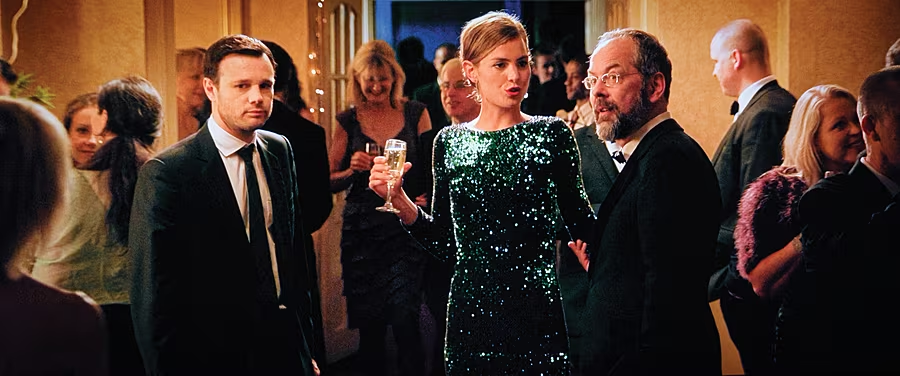
Conor in Irish horror movie The Canal (2014) alongside Hannah Hoekstra and Rupert Evans.
Main Character Energy
The play was the only time I’ve ever played a lead in anything, and even the few times I’ve cast myself in one of my own films I barely made an impression. I appeared as Naked Male Shoulder (uncredited) in a love scene in my first short, and when I later cast myself as Village Guard in a feature film, the Director of Photography shot me from so far away I was playing second banana to the entire village. That village does share a name with a more celebrated place in California, so at least I can say I’ve acted in a movie that was shot in Hollywood (Co Wicklow).
The thing is – I never really wanted to be an actor. No, really. It was just so far from my comfort zone, especially when I was younger, that I felt drawn to it by a curiosity that could only be satisfied by seeing if I could actually do it. When it turned out I could, that was enough. I certainly didn’t expect to learn any valuable life lessons along the way, but despite myself there were some to be had.
The first one came after I stalked across the busy clinic reception area, getting ready to complain bitterly to the temporary receptionist about how much time I’d been waiting to be seen. He looked exactly like celebrated Roscommon comic actor Chris O’Dowd, because it was him, and as he gazed up at me with his trademark supercilious sneer I just knew he’d have a withering put-down ready – I knew, because I’d read the script.
By the third time we’d done it, I was not in a good place. I’d seen during the previous takes that the other actors were all fine, but each time the camera cut, all the director said was “Going again”. All my insecurities rushed in to fill the vacuum, and of course it seemed a fair assumption that the reason we had to go again was because I was being so awful. Looking back, this was a very useful experience for a director who needed to know what actors go through, but no fun at all at the time. After the next take I couldn’t stand it any longer and quietly asked the director if I was even getting close. She looked surprised, said I was fine and she’d only say something if there was a problem. So my first lesson was this: from then on, even if an actor on one of my sets fell over or broke something halfway through a scene, I would always, always, say thank you at the end of each take. This is something I’ve taken into the rest of my life; if someone gives me something, anything, it really doesn’t matter if it’s any good or not, I always say thank you.
I’d done that mortified kid in the church proud – I’d shown him it’s possible to get over yourself, let go of the shame, and do things he’d have never thought possible. All I had to do was to make a complete show of myself.
A little later that day I found myself going properly Method for the first and probably only time in my life – they needed a close-up of Impatient Patient being, well, impatient with Chris O’Dowd, and try as I might I just couldn’t do it believably. As the camera rolled on take five, the sheer frustration at how badly I was acting welled up in me and I involuntarily rolled my eyes as I spoke the lines. “Cut!” called the director, “That was great – moving on”. Lesson two; it’s usually best to go with the gut feeling.
Lesson three is probably the biggest one; being profoundly embarrassed in public, despite all my misgivings, is not actually the end of the world. One thing you can say for it, you definitely feel very alive, and completely in the moment. Surviving it a couple of times has helped me take myself a lot less seriously than I used to, and has greatly lessened my fears about it happening again (it almost certainly will, and it’s okay), which is something I’ve become very grateful for.
I don’t feel the need to act again, but I did do something similar recently which I’ve long dreamed about. Last March I got up on my hind legs and told a true story at the Dublin Story Slam competition. I was extremely nervous, but still felt proud of myself for having given it a go. To my great surprise, I won, so last June I stepped out on the Abbey Theatre stage to tell another story at the Summer Grand Finale. The anxiety was still there, and just before I went on I found myself wishing fervently the Abbey had a thick stage curtain – not to hide behind, but to do an actor’s trick before a performance. They sometimes go out behind the noise-absorbing curtain, as the audience waits on the other side, and shout “F**k you all!” – apparently a great way to steady the nerves.
I didn’t win that night and really didn’t care – I felt very much at ease and actually enjoyed telling the story. The audience enjoyed hearing it, and it confirmed to me that it’s possible to overcome an innate terror of public speaking and move past crippling shyness to the regular shyness many of us have, one which needn’t prevent anyone from doing anything. I know there must be easier ways, but what worked for me was some structured humiliation, a bit of luck and a lot of practice. Ultimately, what really mattered that night was how I’d done that mortified kid in the church proud – I’d shown him it’s possible to get over yourself, let go of the shame, and do things he’d have never thought possible. All I had to do was to make a complete show of myself.
SEE MORE: Artistic License – Conor Horgan