


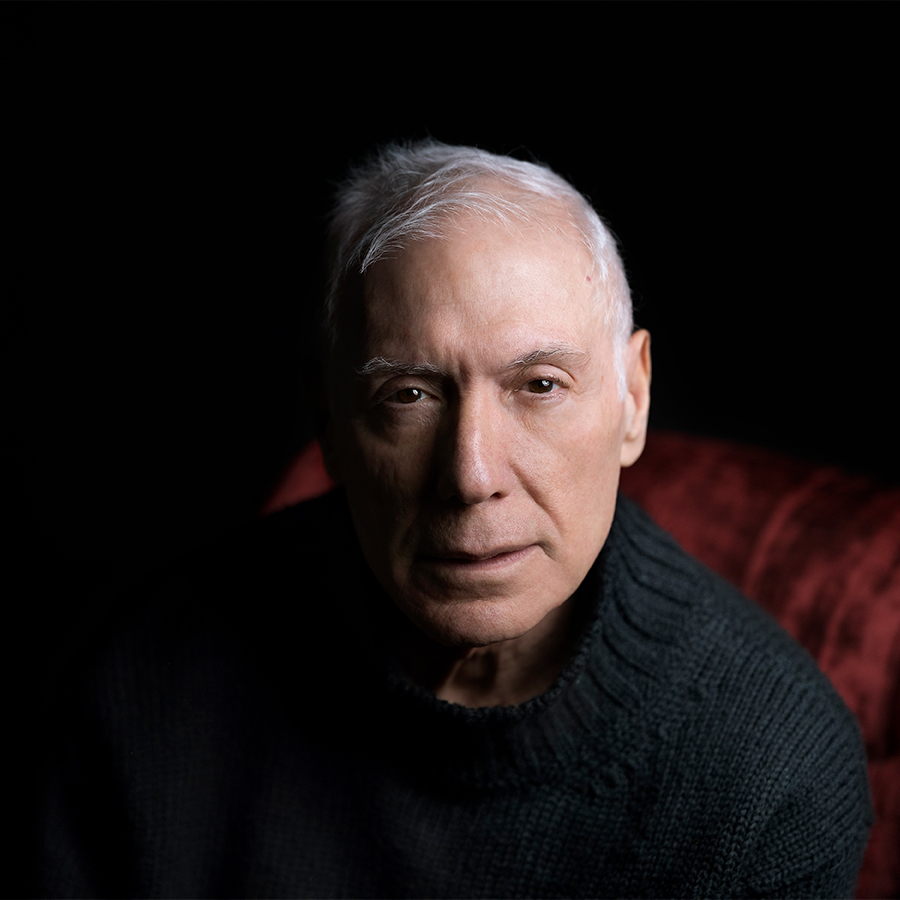
Psychoanalyst Stephen Grosz doesn’t want to help his patients – he wants to understand …
Stephen Grosz is an American psychoanalyst, based in London. He was educated at the University of California, Berkeley and at Oxford University, and has worked as a practising psychoanalyst for over four decades. In 2013, he published his bestselling first book, The Examined Life, which was a collection of insightful vignettes taken from his life as an analyst. His new book, Love’s Labour, focuses on the topic of love, and is illuminated by some of Grosz’s most fascinating cases.
ON THERAPY Psychotherapy is not “helping”, it is understanding. You’re helping people to understand themselves better. A friend of mine can be in a terrible situation with his wife or something, and I can help him move out, but the next day he could be involved with somebody ten times worse. That’s really not helping. My job as an analyst is hopefully that he understands so that his next choice may be a bit better. There’s an analyst I admire hugely, Wilfred Bion. He was Samuel Beckett’s analyst and they greatly influenced each other. He said something very Beckett-like to a patient. He said, “I don’t know why you’re so angry with me, I’m not trying to help you”, which I always find very funny, because what he’s saying is, I’m trying to understand you. Therapy is people telling stories and stories are our way of conveying our experience. When we tell a story, there is a powerful rhetoric, which is “this happened to me” and the underlying rhetoric is, “if you were there and you had experienced what I experienced, you would feel the same way too”.
ON LOVE With Love’s Labour, I wanted to write about love in a different way, the way in which I’d learned about it in my clinical work. I wanted to break from the popular culture kind of love that is stronger than death. In fact, in my book, what gives love its power is that it’s much weaker than death, it does come to an end, we die. That’s what happens. But because of that, love has astonishing power, and it’s very important to us. I wanted to write about love with all of its difficulties, its fragility, the joy.
Pain is the finest instrument we have for knowing our heart.
ON LOSS Life is a series of losses. We leave the womb to be with our mother, and then we have to give up breast milk to have solid food, and then we have to leave the kind of cosiness of being with our mother to go to nursery. Developmentally, to have a new thing, to love a new thing, we have to let go of the old thing. It’s not something that people like thinking about much. The difficult stories of life are often pushed aside by the easy stories, and so part of what I try to do is to show the difficult stories.
ON GROWING UP IN AMERICA I think my parents were wonderfully fair and loving people and my grandparents were very grateful to be living at that time in America when the future seemed so open and positive and you could do anything if you worked hard. During that period of the 1950s, 1960s and 1970s, it was a very optimistic time in America. You didn’t have to worry about money. You would make money if you just worked. If you learned how to use your mind, whether it was medicine or law or some profession where you could help others, you would earn a living and everything would be fine. We were encouraged by our family to do whatever we wanted, and if you used your mind, it was a wonderful thing. And if you used your mind to help people, how amazing! My family was not wealthy, but they felt wealthy because there was always more money coming in than going out.
“Go to where the silence is and say something.”
ON BECOMING A WRITER For a long time, I did professional articles for journals, very formal, academic writing. And then, when I was 50, something changed. I had my children at 50 and I think, because my mother died at a relatively young age and my father had already had two heart attacks, I wanted to start writing to convey what I do in a real way. So, my first book, The Examined Life, was written so that my children would have a clear picture of both me and my work.
ON INSPIRATION On the front page of my notebook, I have two quotes. The first one by Kurt Vonnegut says something like, select a subject that in your heart you care about and that you want your reader to care about. The other quote is from the New York Times journalist Amy Goodman, who was speaking to students at Columbia University. When I read this it choked me up. She just said, “Go to where the silence is and say something.” And I thought, that’s what writing is about.

Love’s Labour by Stephen Grosz (Chatto & Windus) is out now.