

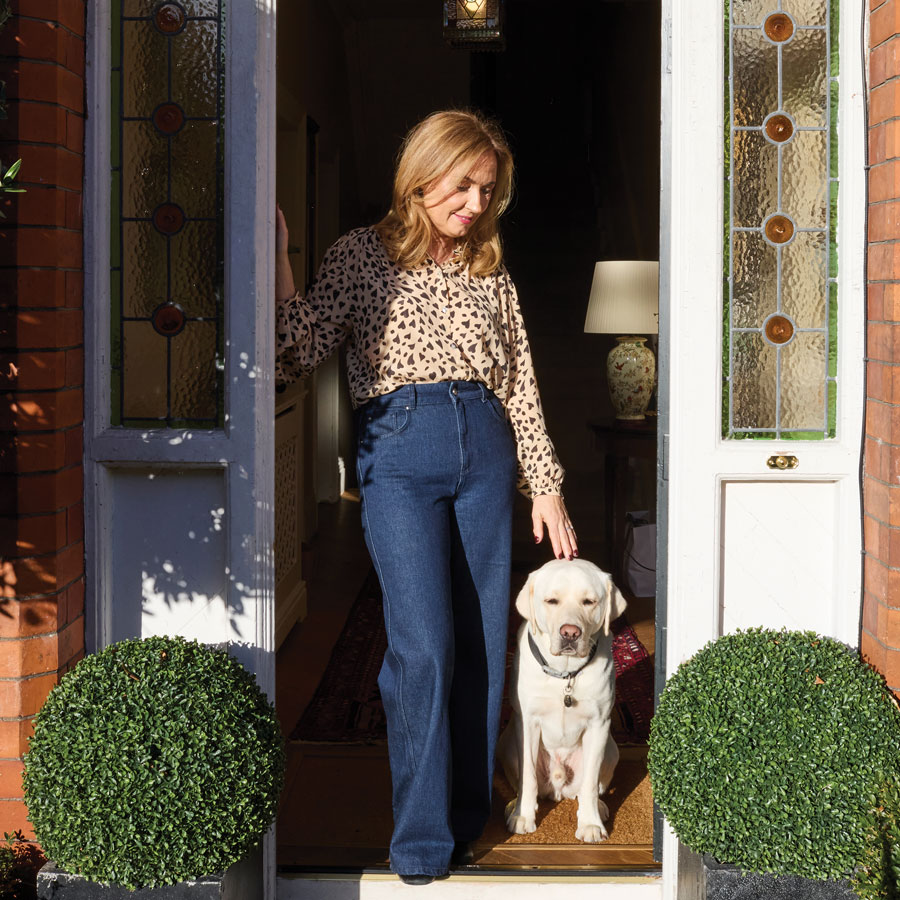
Suzie King, who is registered blind, doesn’t let her disability slow her down …
I was diagnosed with Stargardt’s Disease when I was 14. It’s a genetic condition which makes you progressively lose vision. To me, having it named came as a huge relief. I had been told for years at school that I was just looking for attention. Such nonsense: I was a quiet child, very square, as we used to put it, the last child who would be looking for attention. But finally a doctor said there was something wrong with my eyes. I would never fly a commercial plane, I was told. I’d never drive a car. What did I care? I was 14, I had no intention of doing either. All I cared about was that people would realise I wasn’t making it up. But while I was relieved, my parents were devastated. They understood the long-term picture, that no glasses or intervention could correct this condition, that my already poor eyesight would deteriorate for the rest of my life.
I’m the eldest of three sisters. My mother was (and is) a very stylish woman. Because of (or despite) this, I went to school most days wearing a dress down to my ankles, a velvet bonnet and a coat to match! You can imagine how that went down at our local national school. School was fine, but my eyesight was becoming an issue. I struggled early on. But you don’t know what other people can see. Your norm is your norm. In senior infants, the public health nurse came to the school for an eye check, so I got glasses, but for some reason my teacher put me at the back of the class. In first class, I struggled with reading, and I did the rounds of opticians and ophthalmologists but nothing made any difference.
After national school, I went off to a boarding school in Thurles. In secondary school there was more of everything: reading, subjects, homework, pressure. At my umpteenth ophthalmologist visit, the Stargardt’s diagnosis was finally made. But this was the era of children being left outside the surgery in the hall as parents were briefed. Noone ever explained to me what the condition actually was. I eventually found out that part of the retina, the macula, is damaged, so I have peripheral vision but my central vision is very, very poor.
My parents rang the school and explained. Some teachers were lovely about it. Some were not. One of them still made me read, in that horrible situation when the class is reading a novel, and someone is picked to read aloud. Why on earth would you pick the person who can’t see? It was so stressful. Our principal was very supportive, but there was much less available then in the way of supports or services.
You had to be your own advocate, and I just wasn’t an outspoken person.
The slow and steady deterioration in my sight continued, but I made it to the College of Marketing and Design in Mountjoy Square (now incorporated into TU Dublin). My classmates helped me with reading notes off the whiteboard. I met my husband there, too, and he used to summarise case studies and articles for me. I was well supported by my peers, but the college itself gave me no support. I remember at my graduation thinking, surely when they call me up they will acknowledge that I have got this 2.i despite having an extra challenge. But no. You had to be your own advocate, and I just wasn’t an outspoken person. I’m different now, but that has come with time. I was a quiet person, I wasn’t looking to make waves.
My dad was an engineer, and worked in store development for Dunnes Stores. And my mum, my stylish mum, had a boutique with a friend in the Westbury Mall. She sold Kanga dresses, incredible Hong Kong silks in gorgeous prints, with elasticated waists. People always wanted them for weddings, but you could also roll them up and chuck them into a suitcase. Retail was therefore always in the background, and during my postgrad at the Smurfit School, I wrote my thesis on Brown Thomas, which was moving out of its landmark building in Grafton Street (now Marks & Spencer) into the Switzers building. Customers had strong opinions! It was fascinating, and highly topical. When I completed the dissertation, I met the Brown Thomas MD, and sold my thesis to the store. And then I conducted follow-up research, on how people felt in the wake of the move. I sold Brown Thomas that study, too. Then they gave me a job, and I worked there for two years.
My boyfriend announced that he was moving to London. Off you go, I said, I’m not going. But of course I was going. I got the beauty directory from the Brown Thomas buyer’s office and applied to every single company. I was thrilled when Elizabeth Arden offered me a job. Their office was in Oxford Circus. Now, I hadn’t taken the London Underground into account, quite a challenge for someone with poor eyesight. With my boyfriend, I spent the entire weekend before I started my job practising getting the train and underground from Surrey to Waterloo and on to the Victoria line. We wrote down where to stand on the platform, where to get off the train, where to turn left, where to turn right, how many steps down, where to exit the station. And then I had to do it on Monday morning in rush hour, and then back in the evening. Every morning, every evening. The stress was off the scale. Eventually I moved to Fulham and learned a new route which didn’t involve Waterloo. I can still list every stop on the Piccadilly line.
My job with Elizabeth Arden was in visual merchandising. It might seem ironic, but I’m highly visual. I was used to workarounds, and at work I was highly organised and competent. But it was a challenging, stressful environment. So stressful in fact that when I consulted with a brilliant recruiter about moving on, she told me that first I should go home to rebuild myself. Back to Ireland, back to my parents, which with reluctance I did. And she was right. Six months later, I went back to London and she matched me to a new job, working in a beauty company run by a mad Ferrari-driving Aussie guy in cream linen suits and white shirts.
A dog made it possible to do two-hour mountain walks with friends, to go out at night – things I hadn’t been able to do on my own for years.
After getting married in 2000, my husband and I wanted to come back to Ireland for good, which we did in 2002. Ireland was booming, and we were starting our own family. I opened a maternity clothing shop in Ranelagh in Dublin 6, a happy environment with excited mothers as customers. There weren’t many shops back then where you could get gorgeous maternity clothes. We had Diane von Furstenberg dresses, Earl jeans, Rock & Republic, Elle McPherson. I looked after the customers, and my husband stepped in for things like pricing and spreadsheets. After eight years, we were in a taxi to JFK on the way home from a buying trip, and we heard an item on the radio about the IMF moving in. My husband and I looked at each other. Right, we said. That’s it. And when we got home, we wound up our lovely business.
All this time, my eyesight was getting worse, but I always managed, though there were definitely times I pushed the pram into a dustbin, much to my kids’ confusion. I dressed my two boys in vivid colours so I could spot them across the playground. They’d read their homework out to me. Then one day I was walking in the rain, by the lake in St Stephen’s Green, and I fell in. It was only a metre deep but I was in slimy, shitty, rancid water. I burst into tears and cried all the way home. I got into the shower, got into bed, and didn’t get out for three days. Oh, for fuck’s sake, I thought. The jig was up. I needed help.
Even though I was registered blind, the only aid I’d used since London was a magnifying glass. I just never saw myself as someone with a disability. But after this horrible experience, I decided to apply for a guide dog. That meant getting cane-trained first. I ran into a mum from school at the time, and I remember trying to hide this twometre cane behind me. But as someone told me, people have to know you might need more space, or more time. The cane can signal that.
The process of getting a guide dog took about two years. The matching process at Irish Guide Dogs for the Blind is extraordinary. It’s about the dog’s welfare and contentment. You visit Irish Guide Dogs for the Blind in Cork for training, you bond with the dog, you sleep in a room with it, you practise various scenarios in the street. You come home and they train you on your own walking routes, and off you go. It was liberating. A dog made it possible to do two-hour mountain walks with friends, to go out at night – things I hadn’t been able to do on my own for years.
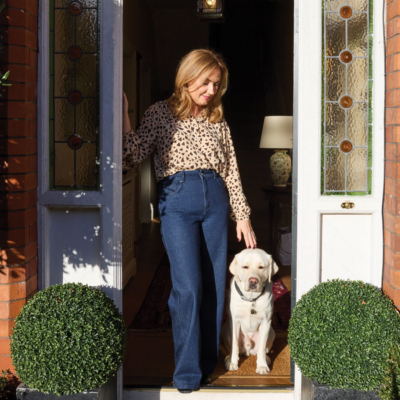
Jonah was my first dog. Regal, handsome, a great character. But he injured the ACL in his knee two years ago and had to retire early, leaving me dogless (Jonah now lives with my parents.) My phone tracks my activity: without Jonah, it dropped by about 30 per cent. Last October, I was matched with a new guide dog, Winston. Jonah was a bit misogynistic, he always really preferred men, whereas Winston loves sitting at women’s feet. But as soon as you put on the harness, he’s working, and he loves it. My activity levels went right back up.
I don’t have to say no. I don’t want to say no. You have to take opportunities.
When a friend rang and told me there was a seat on a tandem for a fundraising cycle from Paris to Nice, I immediately said, sign me up. The call came at a good time. So I did it, and raised over €30,000 for Irish Guide Dogs over two years. And now I’m a tandem cyclist, with two pilots who take it in turns to put up with me on a Sunday morning for practice runs. In spring and summer I cycle every weekend in the Dublin and Wicklow mountains, Howth, Skerries. When the evenings get brighter, I train on Wednesday evenings too. Every September there’s a big cycle trip abroad. I’ve cycled in Croatia, Slovenia and Italy. I even have my own tandem now, a huge machine. I call it the 46A.
I’m not a fast cyclist, but I don’t have to be fast. I don’t need vision to do what I’m doing. My legs are fine, my body is fine. I don’t have to say no. I don’t want to say no. You have to take opportunities. I’ve spoken about this in talks for Irish Guide Dogs, and I’m about to move into talking about it to a wider audience, for corporate clients. When I was hiding my cane, I was worried about how other people would see me. But this shift for me, this evolution, has come about because of how other people see me: not as someone with a disability, but as someone who has gone for it, and who can motivate other people. My story is about resilience. I had to get on with things although I couldn’t see properly. School, college, London, tough jobs, a business. I have a disability but I also have all this ability. That’s true for everyone. We all figure out what we’re good at and we shed or learn to cope with the parts we’re less good at. Sometimes we just have to take a leap to start figuring it out.