



Loneliness isn’t just about being alone. It’s about feeling disconnected from yourself – even when your life looks full from the outside …
In her new book Lonely AF, trauma-informed therapist Dr Sylvia Kalicinski draws on neuroscience, family systems theory and decades of clinical experience to reveal how early relationships and inherited survival patterns shape the way we protect ourselves, often at the cost of intimacy and true connection.
Through her original HEART Method, readers can learn how to recognise familiar patterns, soften defences that no longer serve them and rebuild emotional safety from the inside out. This is not a guide to “fixing” yourself or being more social, but a grounded path back to trust, authenticity and relationships that feel real. She talks exclusively to THE GLOSS about the benefits of mindfulness, yoga and her top tips to prevent emotional loneliness …

Tell us about your work: I’m a marriage and family therapist with 21 years’ experience. I’ve always been trained to think systemically – meaning I look at how our identities and emotional patterns are shaped not just by our psychology, but by the multiple systems we exist within: family, culture, relationships and broader social context. When we widen the lens to include these systems, people’s behaviours start to make much more sense. What often looks like dysfunction is usually adaptation.
I integrate Mindfulness-Based Stress Reduction (MBSR) into my work as an intervention because it supports nervous system regulation while also giving people practical tools. Many of us live with very busy minds – intrusive thoughts, chronic worry and attention that gets pulled in multiple directions – while mindfulness strengthens our ability to anchor in the present, and helps us relate differently to distressing thoughts and feelings rather than becoming overwhelmed by them.
My practice is also deeply informed by neuroscience. When people understand the parts of the brain involved in threat detection, negative thinking and automatic protective responses, shame decreases. Many reactions – especially those linked to trauma or fear – are involuntary survival responses.
Understanding shifts the narrative from “What’s wrong with me?” to “How has my nervous system been trying to keep me safe?”
How does your yoga training influence you? Yoga shapes my work through a nervous system lens. Emotional loneliness isn’t just cognitive – it lives in the body. As a certified yoga instructor, I integrate breathwork, body awareness and somatic regulation into therapy. Rather than only talking about emotions, I help clients notice what’s happening in their bodies – tension, activation, numbness – and learn how to respond without self-judgment or dissociation. That embodied awareness often becomes the bridge between insight and lasting change.
What’s the HEART Method? I developed a five-step framework that integrates all of this trauma-informed practice into a structured yet compassionate process.
H – Honour The Emotion
We have to name an emotion to regulate it. Many of us were taught to “be strong” and carry on. Over time, it often leads to anxiety or other manifestations of repressed emotion. Honouring the emotion doesn’t mean staying stuck in it. It simply means acknowledging what’s happening and reframing emotion as information. Emotions provide messages about what’s happening in our internal or external world. When we treat them as messengers rather than problems, regulation becomes possible.
E – Explore Your Family System
Epigenetics and family systems theory show that many coping strategies are passed down through generations. When people explore family patterns, they often see how emotional strategies – withdrawal, suppression, over-functioning, people-pleasing – were adaptive within their system. This step isn’t about blame, but context. Understanding the system helps depathologise generational cycles and clarify how loneliness may have developed as a biological signal.
A – Acknowledge The Pain Point
Within these systems, we often inherit narratives to make sense of painful experiences: “I’m not good enough,” “I’m too much,” “I’m not wanted” or “I have to handle everything alone.” These pain points are core wounds or self-limiting beliefs that continue shaping adult relationships. Acknowledging them allows us to bring compassion to these responses.
R – Rewrite The Narrative
Many of us still live inside these beliefs that no longer serve us. Often, these narratives are rooted in problems that weren’t ours to carry. Become the author of your own story – transforming inherited or outdated beliefs into empowering emotions reconnecting with possibility. When we revise the story, we shift from self-defeating patterns toward intentional living.
T – Turn Within
The final step focuses on building safety and trust. MBSR tools and somatic practices help you to ground yourself, attuning to your energy and responding instead of reacting. It’s also about creating a personal toolbox to reinforce your rewritten narrative and build a life that feels meaningful and fulfilling.
Tell us about your podcast and book: My podcast, The Dr Sylvia K Show, explores mental health and relationships in a direct, grounded way. I aim to translate complex therapeutic concepts into accessible language without losing their depth. My book expands on this work and explores why emotional loneliness is so common – and why it isn’t a personal failure.
It’s not about being more social – it’s about feeling safe enough to be real.
What are your top tips to prevent emotional loneliness?
1. Notice where you self-abandon or “check out” – especially when you override your needs to maintain harmony or approval.
2. Regulate before you relate. When the nervous system is dysregulated, connection can feel threatening.
3. Practice low-stakes vulnerability – share your feelings more honestly with someone you can trust.
4. Differentiate solitude from disconnection. Being alone isn’t the issue; feeling unsafe with yourself is.
5. Revisit beliefs like “I’m too much” or “I have to handle everything alone” as they may not be necessary anymore.
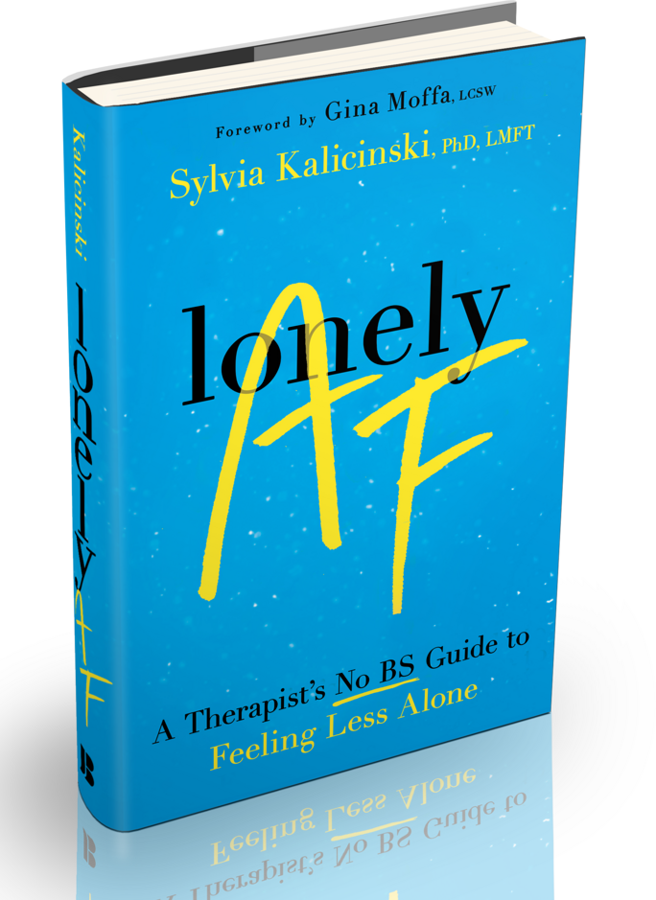
Lonely AF: A Therapist’s No-BS Guide to Feeling Less Alone by Sylvia Kalicinski (Jossey-Bass) is out in March.