

Birr Castle has kept a fascinating fashion archive under wraps for centuries. We witness its unveiling …
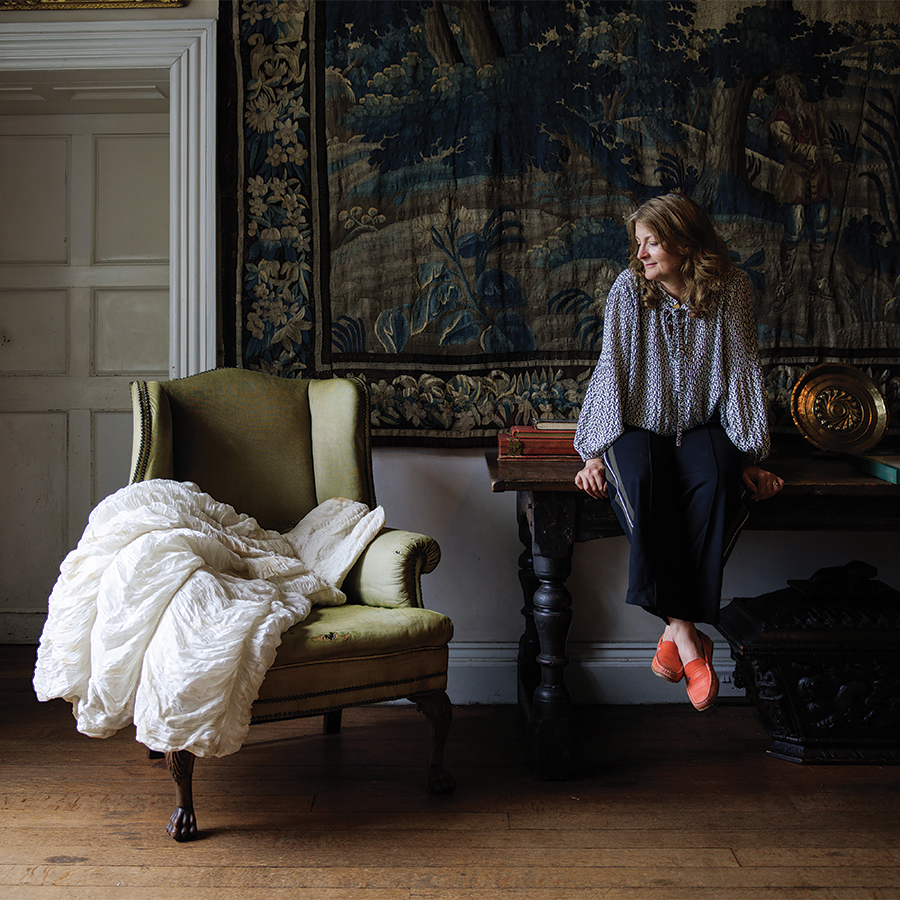
Lady Alicia Clements leads us up wide stone steps and through an arched timber door into the entrance hall of Birr Castle in Co Offaly. The hall is hung with family portraits and 18th-century Belgian tapestries (a wedding gift to the 6th Earl and Countess of Rosse) and has dramatic floor-to-ceiling windows overlooking the gardens, which were redesigned in the early 20th century.

For the first time, Alicia opens a trunk full of very carefully hand-wrapped items sent from Womersley Park in Yorkshire (where her grandmother spent the war years with her children) after it was sold in 2005.
Alicia, daughter of Brendan and Alison Parsons, the 7th Earl and Countess of Rosse, and General Manager of the Birr Trust, grew up at Birr and is evidently still very at home here, though she now lives at Tullynisk House, on the grounds of the 1,200-acre estate, with her own family. Five reception rooms on the ground floor – including the Music Room, modelled after Horace Walpole’s Gothic Revival villa Strawberry Hill in Twickenham, London, and the elegant Yellow Room, which contains not one but two secret doorways – are open to guests who take the Castle tour, and the family are always keen to stop and say hello to visitors, to welcome them in to admire the splendour of their home. The survival of stately homes like Birr depends on the appetite of the public for tours, exhibitions, and seasonal events.

A portrait of Anne, Countess of Rosse.
We turn left into the family’s private quarters and into a vaulted hallway which leads to the 17th-century yew staircase (described in 1681 by Thomas Dinely, an English antiquarian, as “the fairest in all Ireland”). We climb six flights before reaching the top floor, passing busts, tapestries and paintings of the former Earls of Rosse.
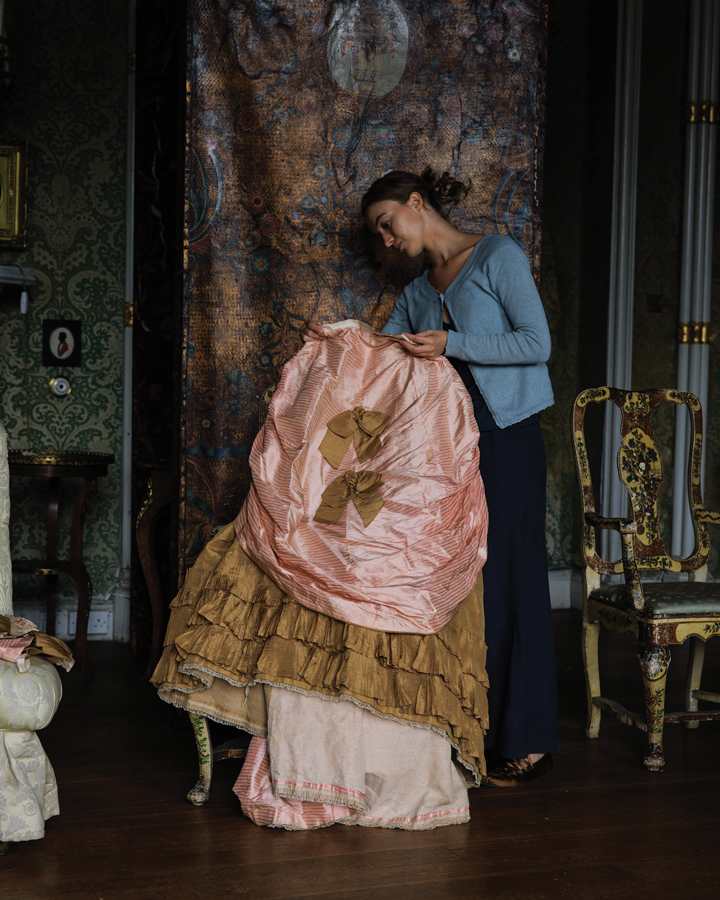
A pink Victorian set from the 1870s, believed to have been worn by Cassandra, Countess of Rosse, who was married to the 4th Earl, is photographed in the Music Room.
In Alicia’s former bedroom, she begins opening boxes of her grandmother’s clothing, along with other historical garments belonging to various members of the Parsons family who have lived at Birr Castle since 1620. Alicia is joint custodian of this collection with her mother, Lady Rosse. “The Parsons family have lived in the Castle for 400 years. So we have 400 years of furniture and paintings, which are very well catalogued, but also 400 years of clothes and needlepoint and soft furnishings. These are almost more important than the paintings and the furniture,” explains Alicia.
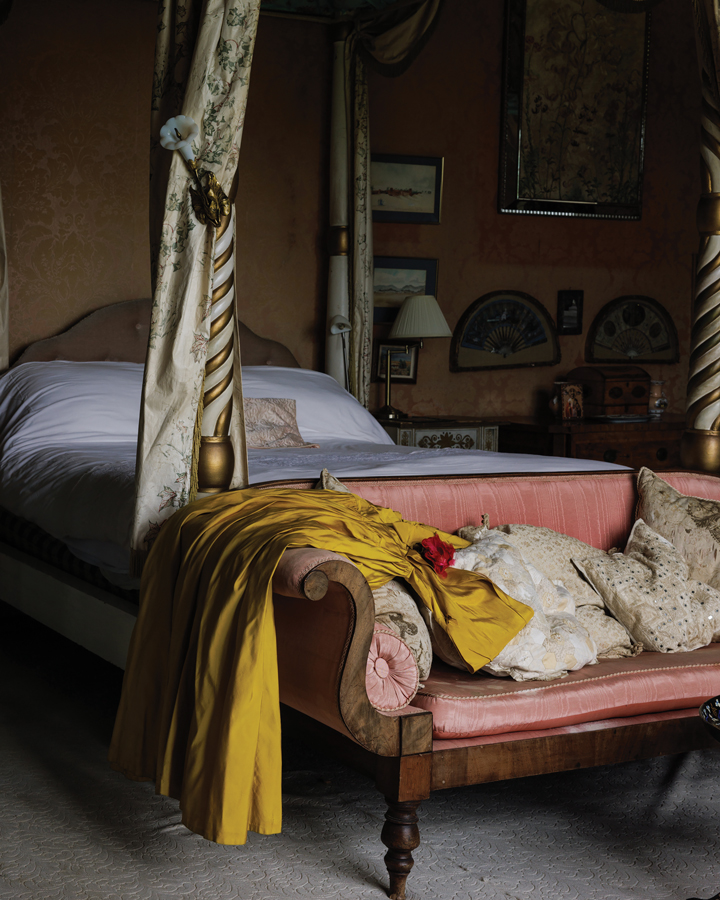
A yellow taffeta dress claimed to have been made by Anne, Countess of Rosse, for her daughter Susan to wear to a ball at Buckingham Palace.
There is work underway. Literally hundreds of family garments have lain in boxes unopened, over centuries in some cases, until this summer, when Alicia enlisted the help of two students from Central Saint Martins in London to archive the vast collection, a project she has been hoping to start for over 15 years. El Aitken and Lily Morgan have sequestered themselves in the Castle’s top-floor rooms for weeks to identify, catalogue and carefully store centuries of dresses, furs, military uniforms from the 1700s onwards, coronation robes, Victorian-era eveningwear, and boxes upon boxes of exquisite hats and handbags, in order to secure the safety of these historically important artefacts. “We don’t even know what we’ve got,” says Alicia. “We’re opening chests that haven’t been opened in 100 years.” She admits that until now storage conditions haven’t been optimal, with many garments still in their original boxes. “As we opened box after box I could see the girls’ faces drop, as more and more precious pieces come out. They were horrified!” Most were in remarkably good condition, considering, but the following day, Alicia ordered hundreds of specialist garment boxes from the Bray Archival Company, and unbleached acid-free tissue paper. In El and Lily’s careful hands, the garments would be safe, and more importantly, documented.
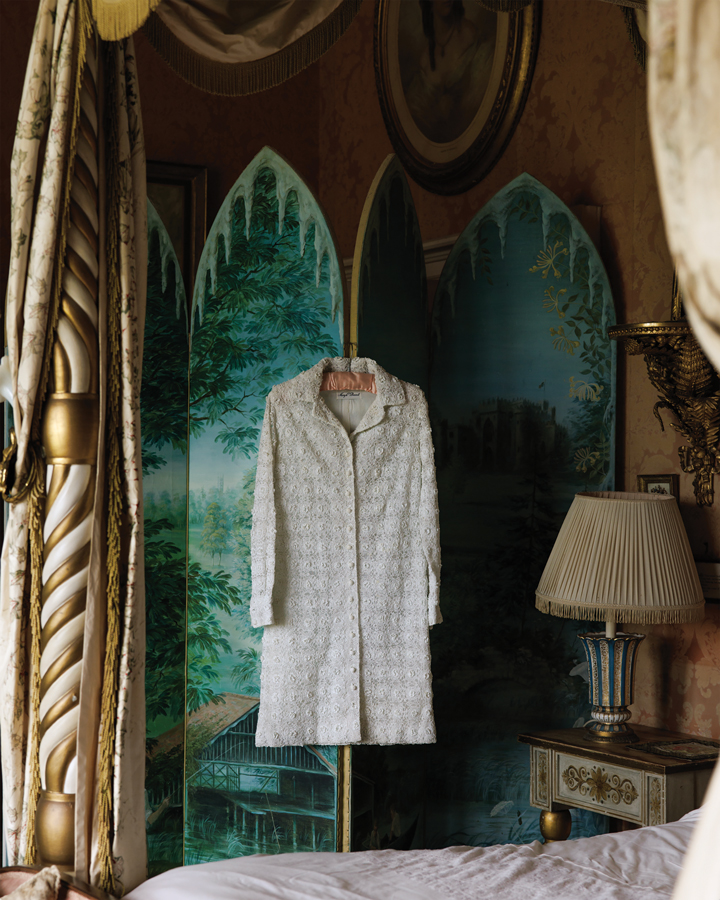
A Mary O’Donnell crochet jacket worn by the current Lady Rosse, in the 1960s, photographed in the Earl and Countess’s bedroom at Birr Castle. The screen was painted by Carl Toms, assistant to Oliver Messel, Anne’s brother, a famous stage and set designer.
In Alicia’s old bedroom, El and Lily have set up a large worktable where they can unpack, examine and catalogue the pieces. Next door, in a room with faded floral print wallpaper, floor-to-ceiling shelves line the walls, with cardboard boxes precariously stacked around the edges of the room. The collection from more recent decades (1930s onwards) worn by Alicia’s mother, aunt and grandmother, contains pieces by some of the most important Irish designers of the 20th century – a pleated linen Sybil Connolly gown from the 1950s, a white crochet jacket and green crochet top by Mary O’Donnell from the 1960s, and a purple Irene Gilbert ballgown. (A hand-beaded Ib Jorgensen cocktail dress is currently on loan to the National Museum at Collins Barracks.)
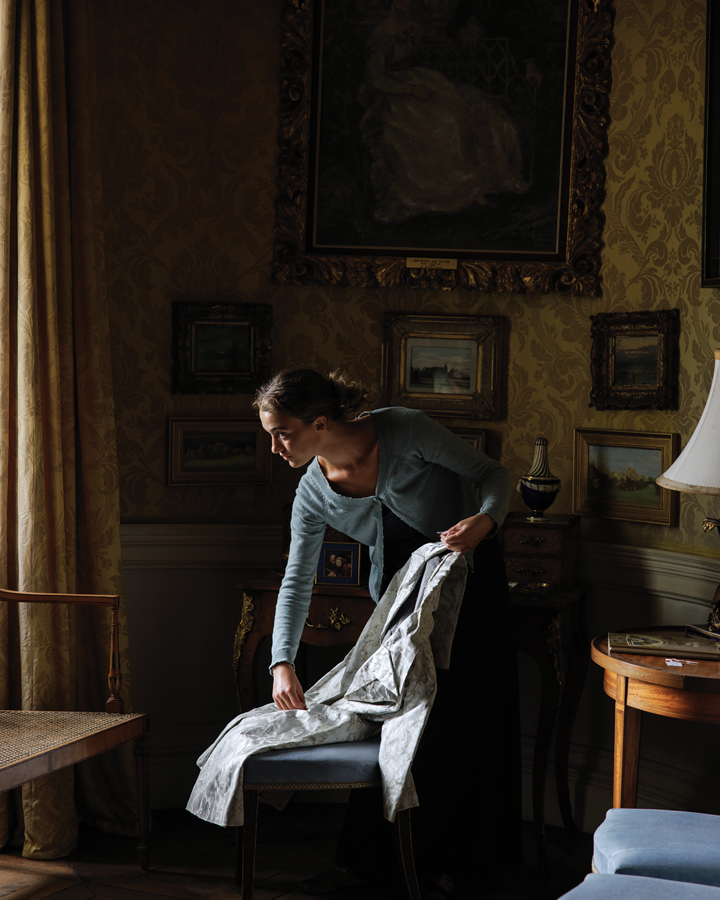
El Aitken holds Anne’s oyster-coloured silk brocade mother-of-the-groom outfit for the wedding of her son Antony Armstrong-Jones to Princess Margaret in 1960.
One of Birr Castle’s most fashionable residents was Alicia’s late grandmother, Anne (née Messel), Countess of Rosse, who married Michael Parsons, 6th Earl of Rosse in 1935. Anne, as we will refer to her from now on, had two sons with Michael Parsons, Brendan (Alicia’s father) and Martin, and two children from her first marriage to Ronald Armstrong-Jones – Susan, who married the 6th Viscount de Vesci, and Antony Armstrong-Jones, who married Britain’s Princess Margaret in 1960. Anne’s mother of-the-groom dress and matching coat for the royal wedding is safely boxed in Birr, complete with a handwritten note declaring how her outfit “was acclaimed by the world as the smartest” at the wedding. Alicia explains that Anne almost always included handwritten notes with special pieces, recording the designer and when they were worn – though she was known to embellish the truth. One note, stored with a mustard yellow taffeta gown, reads: “Susan’s dress I sat up and made in Bridget’s flat in Mount Street for sudden invitation to Buck Pal for the Queen’s first party”.
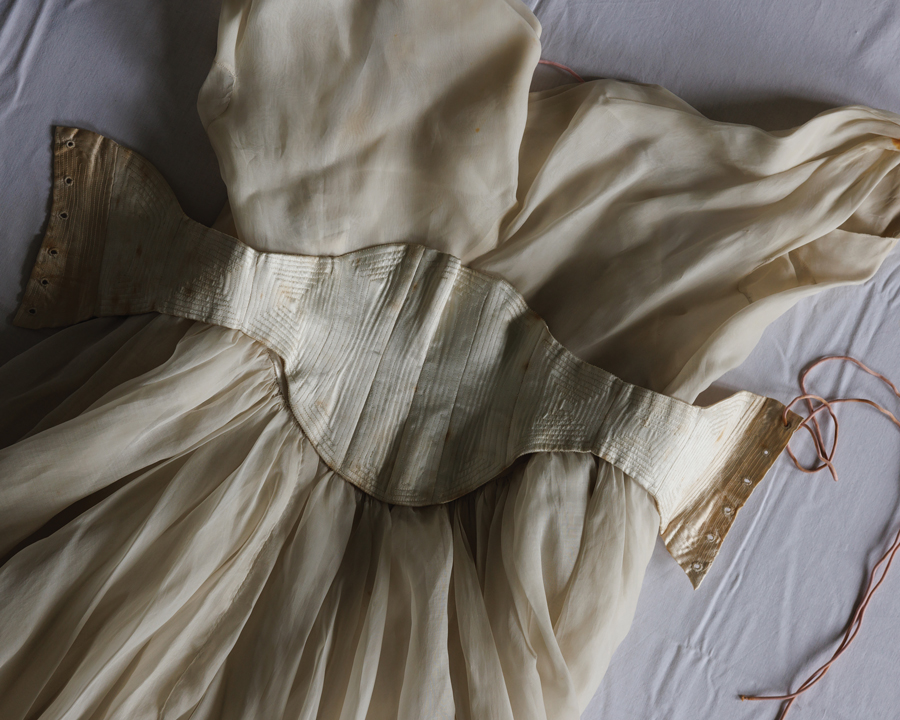
A Charles James dress with corset.
Anne was a permanent fixture on the London social scene, and her wardrobe includes gowns worn to royal parties, coronations and high society events. One of Anne’s favourite couturiers was Charles James, the self-professed “sculptural architect for clothes”. Anne was one of his earliest patrons in the 1930s; some pieces from her collection were lent to The Metropolitan Museum of Art’s Costume Institute in New York for the 2014 exhibition “Charles James: Beyond Fashion”.
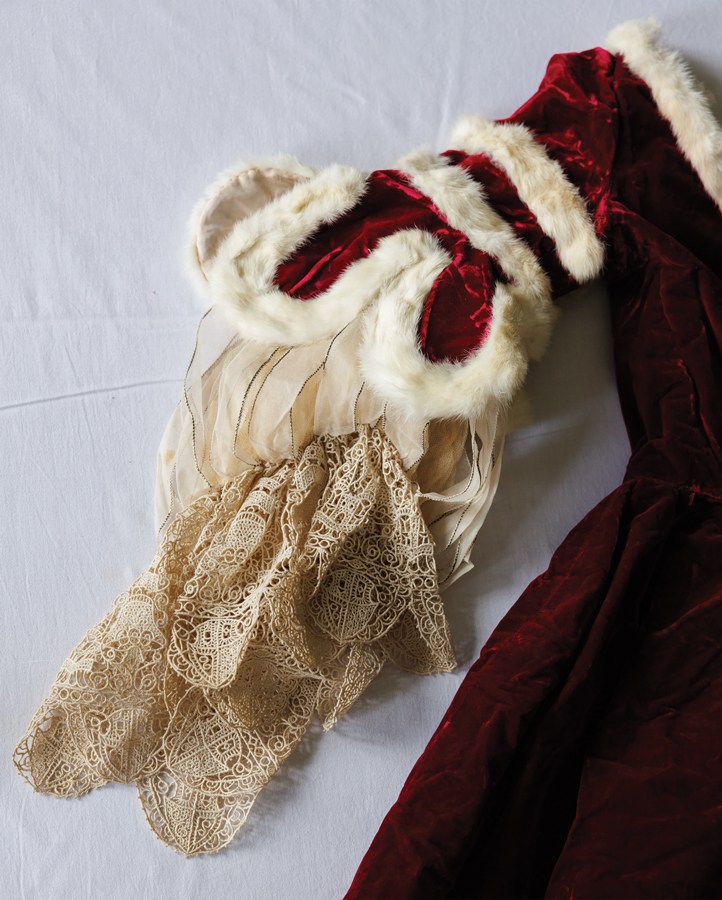
Coronation robes worn by several generations of the Countesses of Rosse date back to 1831. Anne, who attended both the 1937 coronation of Britain’s King George VI and the 1953 coronation of Queen Elizabeth II, had them redesigned; the matching coronet; a detail of a brown wool suit with silk embroidery dating from the 1780s, was worn by Lawrence Parsons, 2nd Earl of Rosse, a member of Irish Parliament, during the debate on the Act of Union with Britain in 1800: he voted against.
As a teenager, Alicia would spend school holidays with her grandmother in Nymans, the Messel family home in Sussex, playing dress-up in these gowns. Fittingly, Alicia and her cousins called their grandmother “Guna” – though Alicia says it’s unlikely she knew the word meant “dress” in Irish. When Anne died, many of her dresses, from various places, ended up in Alicia’s care.
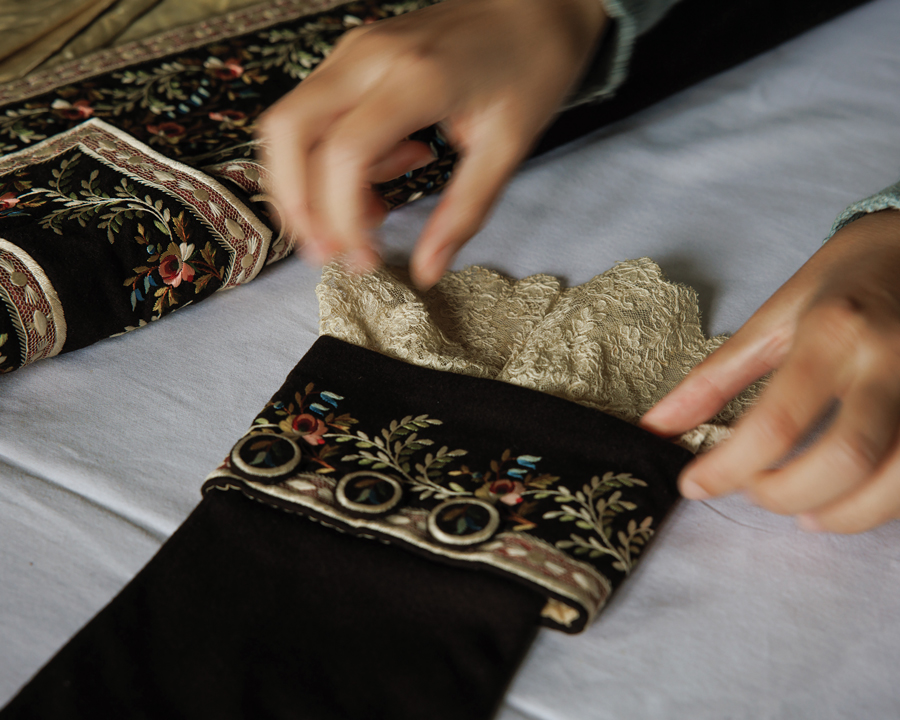
Next year, Alicia is planning an exhibition of the Birr archives at the Castle. In the meantime, some garments will be sent to conservationists for repair. Lily and El will return after their studies wrap up in the spring to continue their work and curate the exhibition. It is a dream job for two students. “You do sometimes sit there in a windowless classroom and think, When am I ever going to need this knowledge of 18th-century waistcoats,” says Lily. “And now look, this is why we need it!” Once the archive is organised and categorised, it’s likely Birr Castle will get more requests for loans from museums and galleries worldwide, as archivists and researchers access the new catalogues online.
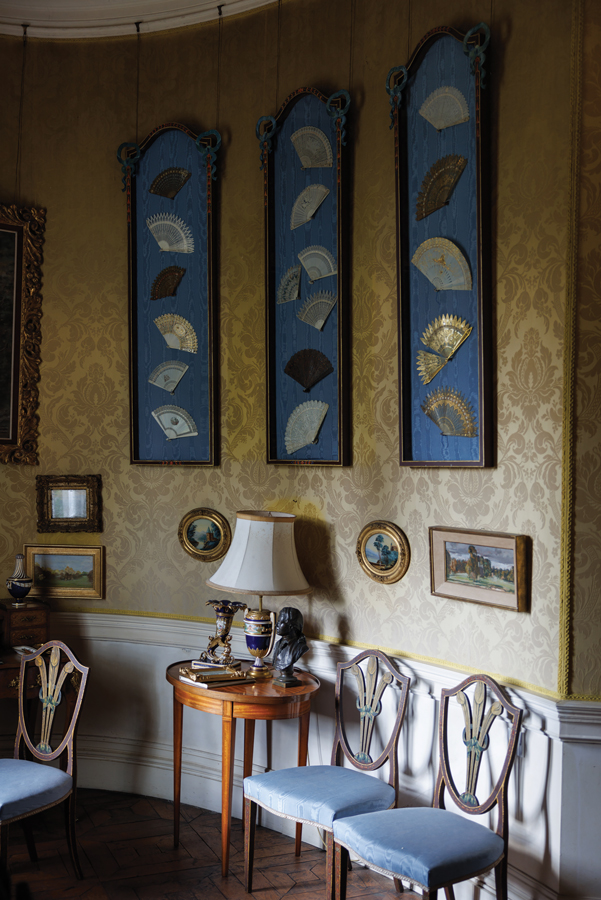
The Messel family famously collected fans, a number of which are on display at Birr Castle, though over 100 lots were donated to the Fitzwilliam Museum in Cambridge.
After that, Alicia insists, the items should go back to their rightful homes. “I want these items to be in the right place, looked after by the right people,” says Alicia. “There are some things that have ended up in Birr that would probably be better appreciated where they originated, or where they tell a better story.” For Alicia, it’s about ensuring the future legacy of the historical garments, when the family may not be here to tell these stories. “It’s really important in the history of our family to catalogue this.”
As we prepare to leave the Castle, Lady Rosse arrives home. I thank her for allowing us into her home for the day, and to witness the unveiling of such a fascinating historical archive of some of the family’s most personal belongings. She responds: “That’s what this place is for.”
NOTE All garments and accessories featured in this article were photographed in accordance with recognised archival and conservation standards. Each piece was carefully examined to confirm it was safe to handle and photograph. Throughout photography and handling, every precaution was taken to preserve the integrity and condition of the garments and accessories.
Birr Castle tours will recommence in the spring. News about the archive exhibition in summer 2026 will be shared on www.birrcastle.com.
SEE MORE: Inside Tommy And Dee Hilfiger’s Lovingly Restored Country House