



Sadness can be useful, argues Helen Russell, who digs into her own history and gets advice from the experts in her book, How To Be Sad …
Sadness is the temporary emotion that we all feel on occasions when we’ve been hurt or something is wrong in our lives. It is a message.
We depend on each other to survive as a species and sadness is the emotion that makes us remember this – because the most common ways to avoid sadness are really ways to avoid feeling. Like trying not to get too close to someone for fear of getting hurt (I’ve been there …). Or avoiding the pursuit of meaningful goals in case we “fail” at them (check …). Or forming addictions to blot out the pain or numb our senses and so “protect” ourselves. Or working all the time, busying ourselves with the hamster wheel of life and distracting ourselves from uncomfortable feelings by scrolling through social media, just for example.
If we aim to avoid sadness, even a little, we limit our existence and put ourselves at greater risk of normal sadness tipping over into something more serious.
Suppressing negative or depressive thoughts, to the extent that many of us probably do on a daily basis, has been proven to backfire spectacularly, resulting in depressive symptoms, according to studies. The Harvard University psychologist Daniel Wegner famously led a thought experiment in 1987 where subjects were told not to think about white bears, inspired by the Russian writer Dostoevsky, who once wrote: “Try to post for yourself this task: not to think of a polar and you will see that the cursed thing will come to mind every minute.” So Wegner decided to put this idea to the test.
For five minutes, participants were asked not to think about a white bear, but to ring a bell each time a white bear crossed their minds. Participants in a second group were allowed to think of anything they wanted, but continued to ring a bell each time the thought of a white bear surfaced. The second “expression” group rang the bell far less frequently than the first group, who’d been suppressing their thoughts. A second experiment replicated these findings and Wegner later collaborated with the psychologist Richard Wenzlaff to test the theory further, confirming that trying not to think or feel something sad makes us more prone to anxiety, depressive thoughts and symptoms. It may sound counter-intuitive, but Wegner and Wenzlaff concluded that fighting “sad” actually makes the “sad” worse.
This was certainly my experience.
I know “sad” just as intimately as I know “happiness”. My first ever memory is the day that my sister died, of sudden infant death syndrome (SIDS). My parents split up soon after. I’ve had a sketchy relationship with my body and with food. I’ve had career setbacks as well as relationships that have imploded in agonising ways. Infertility, IVF and bed rest weren’t exactly a hoot either.
Even the things that have brought the greatest joy have also brought challenges. Challenges that have been harder to process than they might have been – because we don’t tend to talk about sadness enough in our culture. Many of us will have been raised with the assumption that “what we don’t talk about can’t hurt us”, and, for a long time, “not talking” about being sad was seen as a sign of strength. But really, the opposite is true.
Learning how to be sad, better, is something we need right now, more than ever.
During the pandemic, much of what we relied on and took for granted was gone. The enforced slowness of lockdown stripped everything back, so that our internal dialogue could be heard more loudly – with no respite or escape to the busyness of “normal” life. No one was sure what the world would look like after or how we’d recover. Many of us experienced losses and all of us felt something change. And because we’re more globally connected – at least, digitally, today – we’re more aware of what’s going on around us.
It’s now estimated by the World Health Organization (WHO) that hundreds of millions of people globally are affected by depression. Of course, sadness isn’t the same as depression (I should know: spoiler alert, I’ve done both). WHO defines depression as persistent sadness and a lack of interest or pleasure in previously rewarding or enjoyable activities. Depression often disturbs sleep and appetite, resulting in poor concentration.
There are six common types of depression: the first is major depression, what many of us probably think of when we hear the word “depression” – a clinical condition with symptoms along the lines of the WHO’s definition. Then there’s persistent depressive disorder, referring to low mood lasting for at least two years but that may not reach the intensity of major depression. There’s also bipolar disorder; seasonal affective disorder; a severe form of premenstrual syndrome called PMDD; and perinatal depression that can occur during pregnancy or in the first year after a baby is born (also known as postpartum depression). Clinical depression is serious and usually requires professional help. But a refusal to sit with standard, unavoidable sadness – and a lack of knowledge as to how best to handle it – can lead to depressive symptoms (see Wenzlaff and Wegner above).
“Many people nowadays assume that if they’re not happy, they must be depressed,” says philosopher Peg O’Connor, Chair of the Department of Philosophy at Gustavus Adolphus College in the US, “But life isn’t like that – there’s a whole swatch of emotions and ways of being that are viable. As Aristotle says, happiness is an on-going activity; it doesn’t mean that you’re never unhappy or that hard things haven’t happened. Life is hard and there are challenges – but that doesn’t mean that you can’t have a good life.”
Much of what makes us sad may be unforeseen; few of us predicted Covid knocking us sideways. But other episodes of sadness can be relied on – scheduled, even. Researchers have found that our lives typically follow a u-shaped curve – we’re happier at either end with a distinct dip in middle age. Economists David Blanchflower and Andrew Oswald started noticing recurring patterns in life satisfaction studies back in the 1990s. By 2017, they published meta-analysis showing conclusively that contentment declines for the first two decades of adulthood, hitting rock bottom in our forties, then creeping up again and sending us near giddy into our senior years. As unlikely as it sounds for those not at all happy to be nearing death, the trend plays out worldwide. The loss of happiness between the ages of 25 and 40 has been found to be equivalent to one-third of the effect of involuntary unemployment.
These should be times when we feel the most connection with our fellow human beings, yet they’re often the times when we feel most alone – retreating rather than reaching out. We may be embarrassed to admit that we’re sad. Other people may be embarrassed that we’re sad. We may be embarrassed that they’re embarrassed. Either way, we feel shame.
Many of us instinctively tell ourselves that we “shouldn’t” feel sad, that others have it worse. We worry that our sadness – our own brand of hurt – is somehow less “legitimate” than others. “Unworthy” even.
But pain is pain, however privileged. This is not to minimise or make light of others’ suffering; it’s about being aware and attentive to our own, too. We have to care about the world around us and help others. But we still get to hurt. If we’re feeling sad, we should let ourselves feel sad and allow the emotion to move through us, since sadness can be useful and we all get sad to varying degrees.
No one can be happy all the time. The lows help us appreciate the highs and to be truly content, we have to make friends with “sad” too. I’ve spent the past four decades learning how: in loss, heartbreak, friendship and family life; through addiction, adverse circumstances and in depression. We may not have experienced exactly the same “sad”, but the steps are the same and by sharing my story, I hope I can encourage others to do the same. We are all different, but there is universality in the specifics.
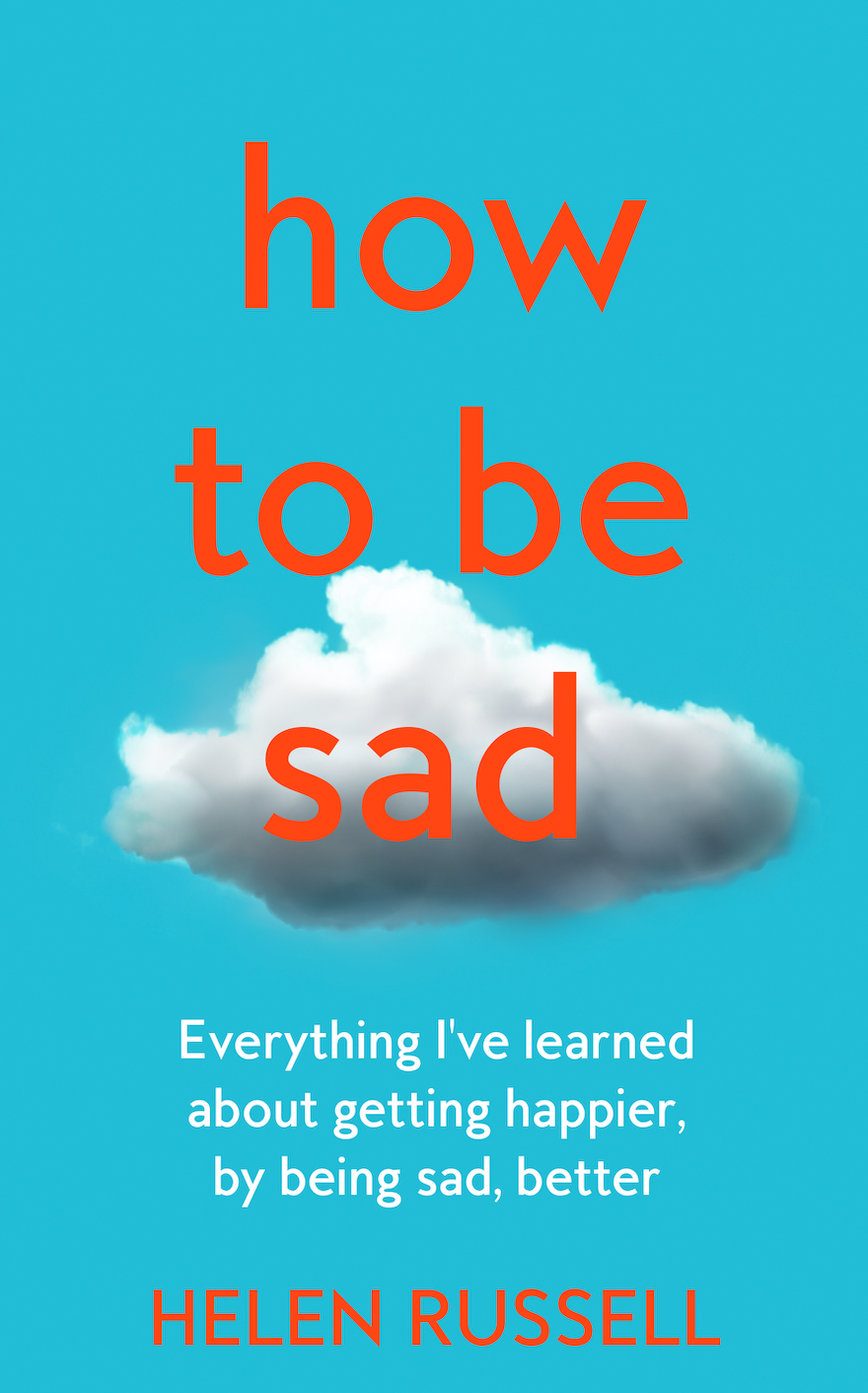
From Helen Rusell’s How To Be Sad: Everything I’ve Learned about Getting Happier, by being Sad, Better, published by 4th Estate.
SEE MORE: Blue Art Inspiration To Beat Blue Monday