

Sasha Sykes’ exhibition “Filial Love” at the RHA Gallery will run until March 26. Ruth O’Connor went to the opening …
Lovers of art, gardening and craft will be drawn to the latest exhibition of work by Sasha Sykes, “Filial Love”, which runs until March 26 at the Royal Hibernian Academy in Ely Place in Dublin 2.
An estimated 1,000-plus visitors attended the exhibition opening which saw three other exhibitions open at the RHA on the same evening. Notable attendees at the Filial Love opening event included THE GLOSS contributor Susan Zelouf, Irish Times fashion editor Deirdre McQuillan, art historian and author Barbara Dawson, Appassionata founder Ruth Monaghan, Head of Design for Body and Environment at NCAD Angela O’Kelly and author Sebastian Barry.
Also in attendance were Paul and Kathy McGuinness, Hugo Jellett, Catherine Ann Heaney, Helen O’Connell, Sasha Sykes’ brother author and historian Turtle Bunbury and her mother Jessica Rathdonnell – the woman that inspired the exhibition and to whom it is dedicated.
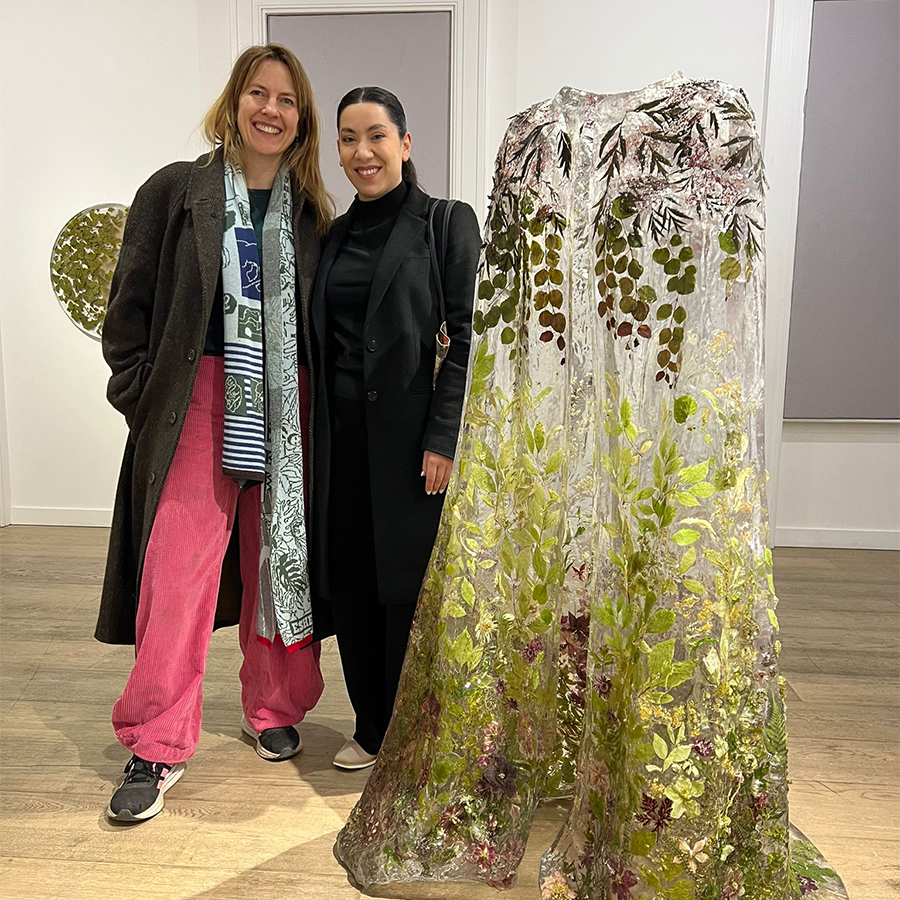
Sasha Sykes with Sarah Doherty of Burtown House at the RHA Gallery.
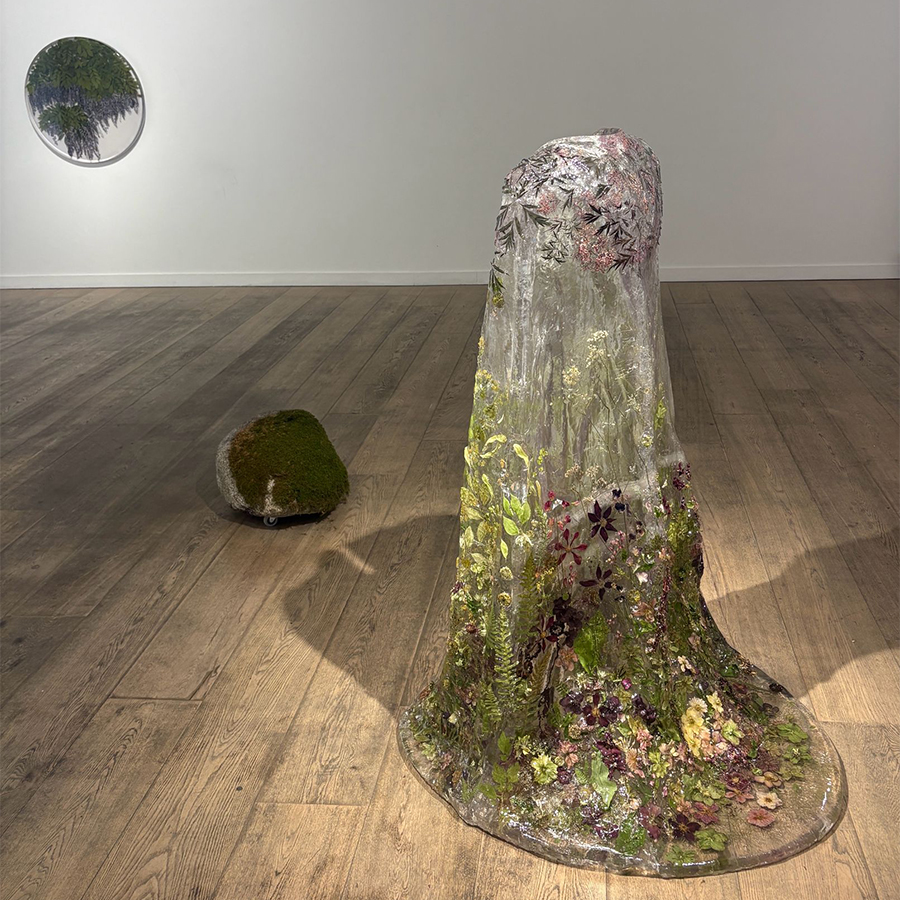
“Filial Love” brings together sculpture, video, soundscape and wall-mounted works to explore nature through the lens of familial bonds, specifically that of the mother/ daughter relationship. The exhibition is anchored by The Keeping, a freestanding installation of a full-length, floral resin cloak, inspired by Jessica Rathdonnell’s own frame, which is positioned in dialogue with a moss-covered granite boulder at the centre of the space. The various elements form a meditation on protection, labour and enduring care – personal, generational and ecological.
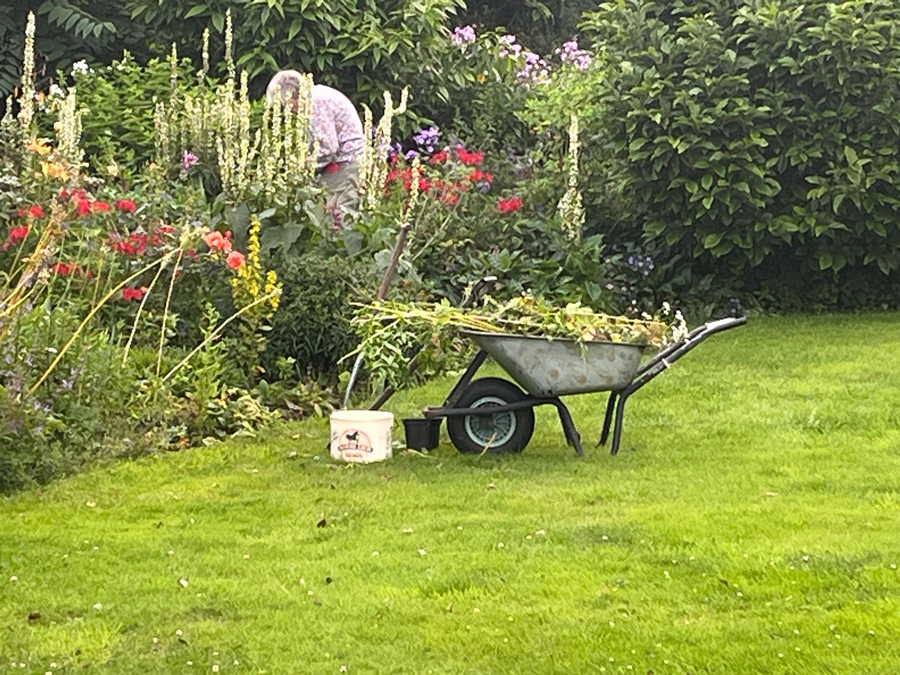
Jessica Rathdonnell at work in her garden.
“Filial Love” draws deeply on the artist’s close relationship with her 85-year-old mother, Jessica Rathdonnell, and Jessica’s work as a celebrated gardener. Responsible for restoring Lisnavagh’s gardens, designed by Daniel Robertson in the 1850s, Jessica has also created a noteworthy garden of her own at her 20-year-old home on the estate. Her eldest son William now lives in Lisnavagh House with his wife and family and the estate is both private family home and a popular destination for retreats, weddings and events.
“I wanted to document my mother’s garden over the course of nine months,” Sasha Sykes tells THE GLOSS at the RHA. “But as I started working on the project, I began to realise that her garden is a place where we have a very special relationship – a relationship free of judgement and weight. When my mother got married, she went to live at Lisnavagh where the beautiful Daniel Robertson-designed garden had been left for a couple of generations. She began to restore it with the help of gardener Peter Cullen – becoming well known for her skills and knowledge. Her life, community and friends revolve around it.”
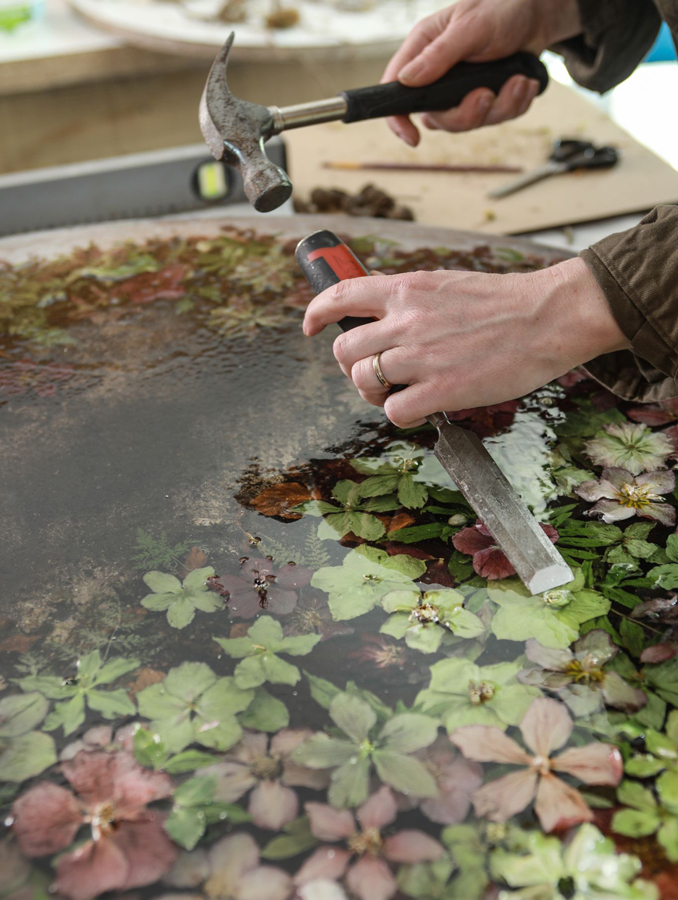
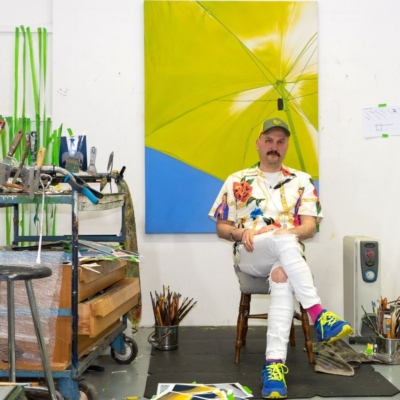
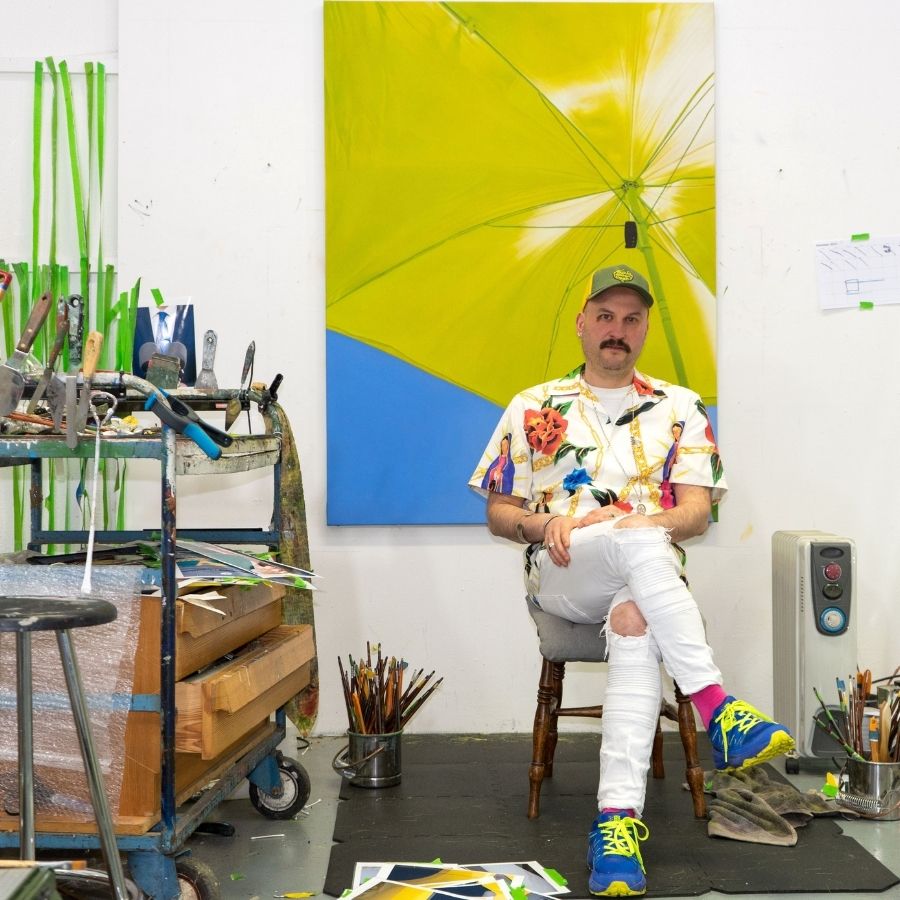
Sasha Sykes at work in her studio.
Represented by the Oliver Sears Gallery, Sasha is renowned for her sculptural artworks which include wall-mounted pieces, screens, and items of furniture. While others make work using similar materials, few have attained the same level of finesse that Sasha has. The process she uses to create each piece is akin to lacquering in that it involves the building up of many layers of resin and organic matter to achieve works which are characterised by a depth of field, sense of colour and dynamism that others struggle to emulate.
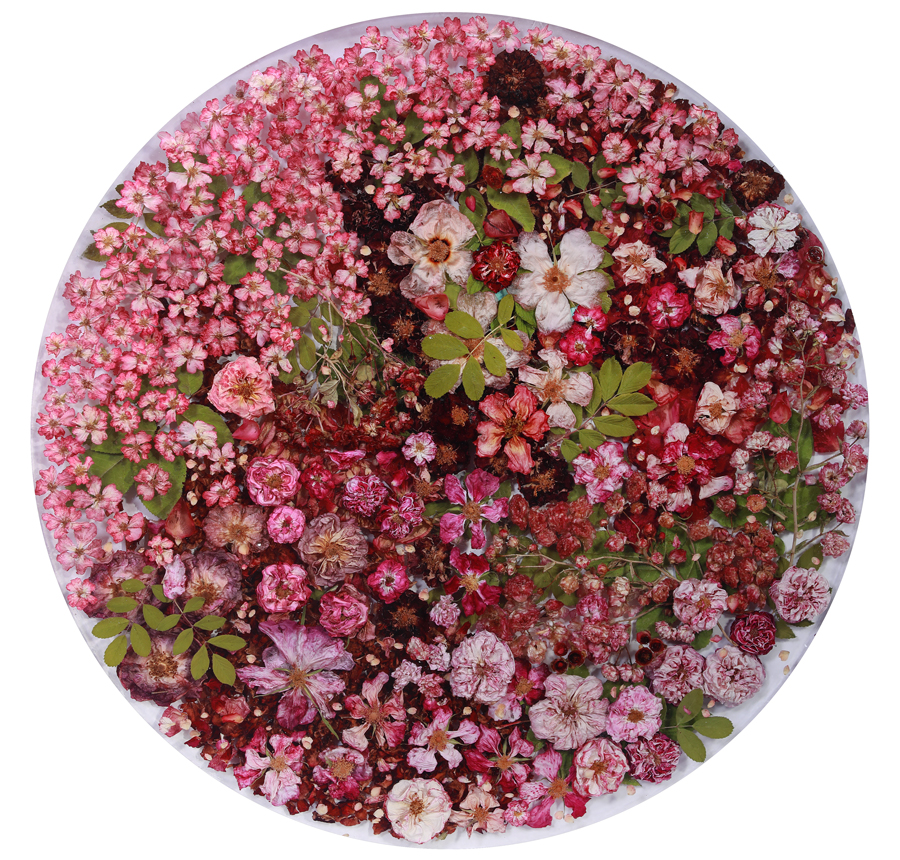
Anam Cara. Photo Rory Moore.
The wall roundels in “Filial Love” at the RHA involve a detailed process that involves the collection, editing and processing of a huge amount of natural material such as plants, flowers, leaves, soil and moss. “The wall pieces involve plants collected on eight to ten different days. The best of the plants collected are then selected to be dried in a variety of ways – some are hung upside down in warm dark places, some are wrapped in newspaper, some are pressed, some are dried in a dehydrator – even a microwave and silica are occasionally employed,” explains the artist.
“You have to be careful how you dry things and it takes time – invariably you cannot dry some things too quickly or they will disintegrate. You also need a lot of space too to handle this volume of material, and the material must be totally stable before it can be placed in the resin.”
Once she has gathered and dried the plant material, Sasha begins adding thin layers of background strata such as soil or moss into a unique mould. She builds from the background to the foreground, layering the flowers and foliage carefully, sometimes one petal at a time, along with layers of resin to build up the final piece which is then cut to size, routed, sanded and polished.
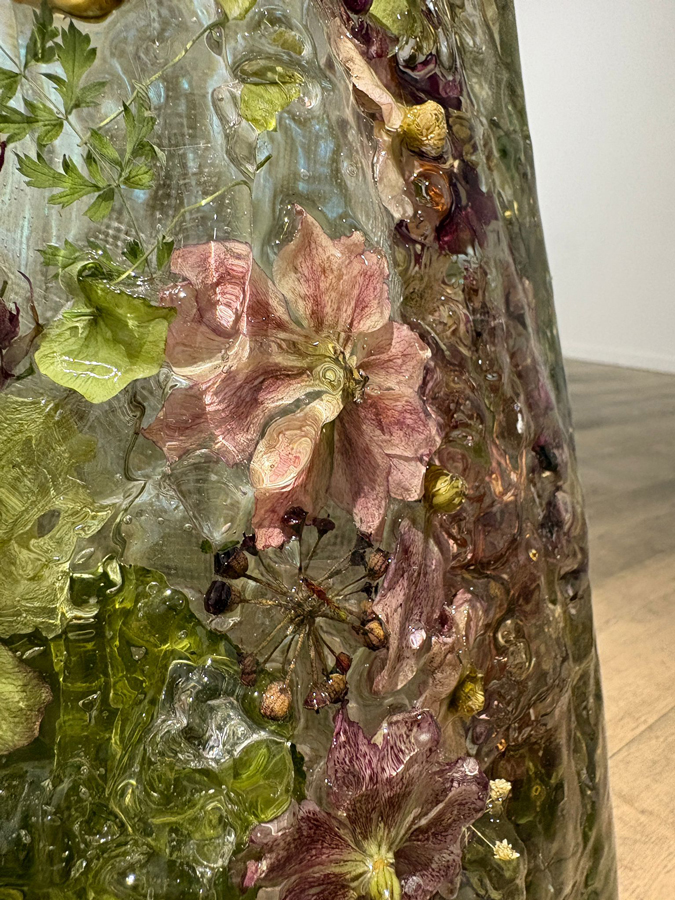
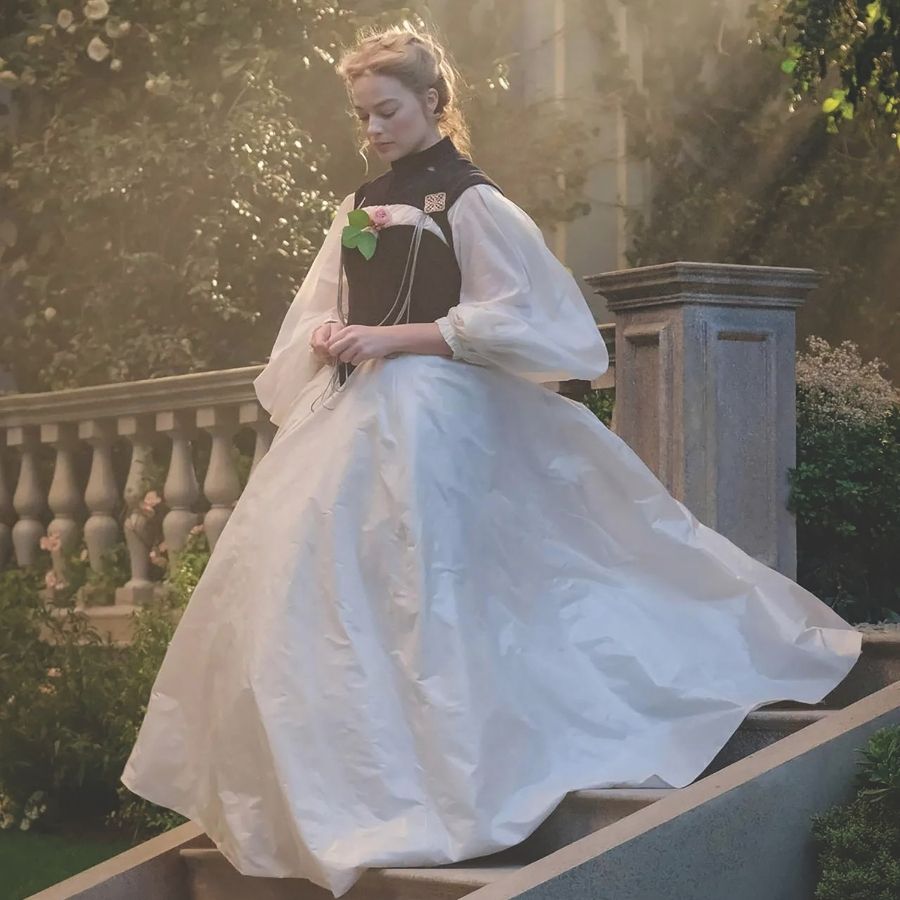
Details of the cloak.
The floral resin cloak in The Keeping at the centre of this exhibition marks a new departure for the artist in terms of technique. “For this exhibition, I wanted to do something looser – something that had more free-flowing moving energy to tie the other pieces together,” says Sasha.
Referencing her time at the Grafton Academy of Fashion Design, during a recent artist residency at Ballyfin Demesne Sasha began creating pattern blocks in calico based on some of her mother’s own cloaks and on her mother’s silhouette.
“This cloak was a seven-week project in the casting room. I wanted it to be sketchier and looser than my other pieces. I like how the flowers and foliage emerge from the form of the cape. There are 160 or 170 castings in this piece which is then sanded and shaped to create the final form,” explains Sasha, who was inspired by the pre-Christian Irish tradition of mothers giving their daughters a cloak as a parting gift upon marriage.
While wrought in a hard material, the cloak gives the impression of a fluid fabric resting on a human form – the shoulders hang slightly differently here, there’s an impression of the bend of a knee there, the ‘fabric’ pools on the ground behind the invisible wearer.
Much of the plant material in the cloak is echoed in the other pieces in the exhibition. The top mantle features the lace-like Black Elder which also appears in Sasha’s Protection piece. Heart-shaped katsura leaves drape elegantly from the shoulders of the cloak which also features koelreuteria, philadelphus, Lady’s Mantle, astrantia flowers, umbellifers, clematis and hellebore.

Serenity II.
“Each of those plants has an aspect to it that I connect with my mother – the clematis for example you can throw anywhere and it’ll figure out how to climb, others are associated with protection and others like Hellebores bring us colour in the darkest days of winter,” says Sasha.
The granite rock reflects the granite of the quarries local to Lisnavagh: “Granite is the soil that my mother’s garden is built on which is why she gets that incredible blue in the hydrangeas that you see in the Reassurance piece. The rock is of the land and it’s nurturing the moss – it’s about caring, protecting and nurturing without ownership. It says so much about the mother/ daughter relationship but also about the relationship that we should have with the land,” says Sasha.
“I will sit with flowers collected over, perhaps, 30 different days, and, like a painter with their palette of different blues, I will dive into the blue zone selecting flowers and petals to create a sense of colour and depth,” says Sasha of the Reassurance piece. Another piece, Serenity II, is inspired by the woods and quarries near her mother’s home. “It’s a place I go to a lot since my dad died last year – it’s a very meditative space.”
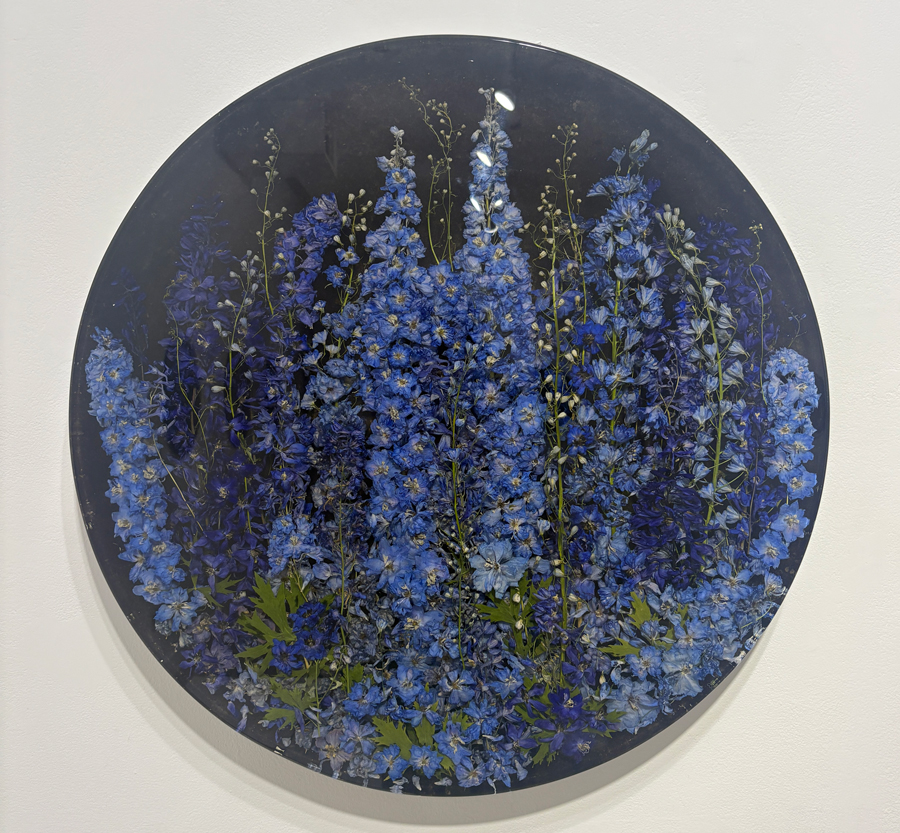
Joy II.
Another blue piece in the exhibition is Joy II which employs delphiniums sourced in the perfect shade of blue by Jessica Rathdonnell for her daughter’s work. Sasha references the pioneering fashion photographer Edward Steichen who worked for Vogue in the 1920s and ‘30s.
“He was obsessed with delphiniums and bred them in his garden in upstate New York. “In 1936 he was the first person to put on a show in MoMA that featured only plants – the “Steichen Delphiniums” show. He was obsessed with the colour and the verticality of delphiniums. In his photos they are often pictured with a black backdrop and I was inspired by that, using soil to create the backdrop to the flowers in Joy II.”
“Filial Love” is accompanied by a film by Cuan Roche which features Jessica’s hands at work in her garden as well as a soundscape by Will Worsley – birdsong filling the air in the RHA space and transporting the visitor far beyond the city centre setting.
“When you’re a mother and a gardener you are working all the time, so I wanted to reflect the constant rhythm of that work and of the seasons – the slow rhythm of my mother’s hands at work, the dirt under her fingernails, the insects in her garden,” says Sasha. “Like my mother, many gardeners plant certain plants because of the ecosystem they’re creating. As humans we can bring so much destruction to the land, and yet, with careful curation, we can do so much that is positive.”
Visitors to Sasha’s exhibition at the Voltz Clarke Gallery in New York before the last US presidential election were quick to remark on the sense of calm they experienced during this frenetic period in politics. “I hope people will feel that same sense when they visit Filial Love at the RHA,” says the artist.
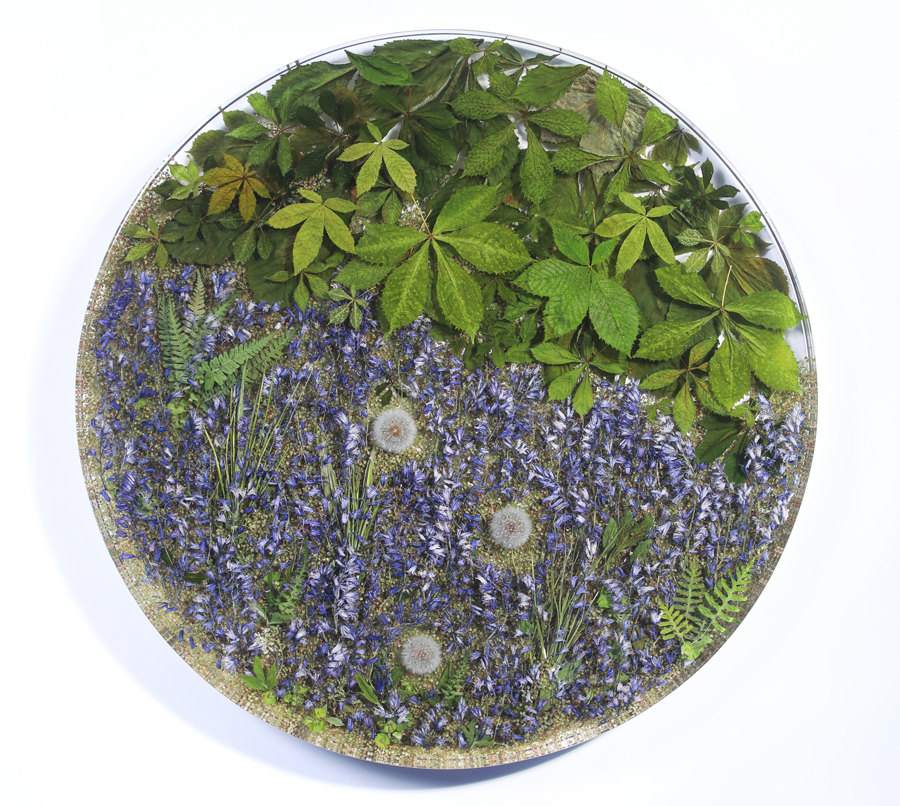
Hope.
“I particularly love Hope, which features the bluebells from around my mother’s home. There’s a feeling that you get from being in a garden. It’s the same unconditional love, security and sense of care that I get from my mother and I am so lucky to be able to celebrate that.”
Need to know: Filial Love runs until March 26 2026 at the Royal Hibernian Academy, 15 Ely Place, Dublin 2; www.rhagallery.ie.
For enquiries: Visit www.oliversearsgallery.com.
We may earn a commission if you buy through affiliate links on our site.