Artistic License: Yanis Miltgen
The Luxembourg-based sculptural textile artist and experimental embroiderer explains how he creates gardens that never fade …
“I define my work as contemporary textile sculpture, deeply rooted in craftsmanship and the observation of nature. I use techniques such as embroidery, crochet and knitting, and take them beyond their traditional context, bringing them into sculpture and, at times, into monumental dimensions.
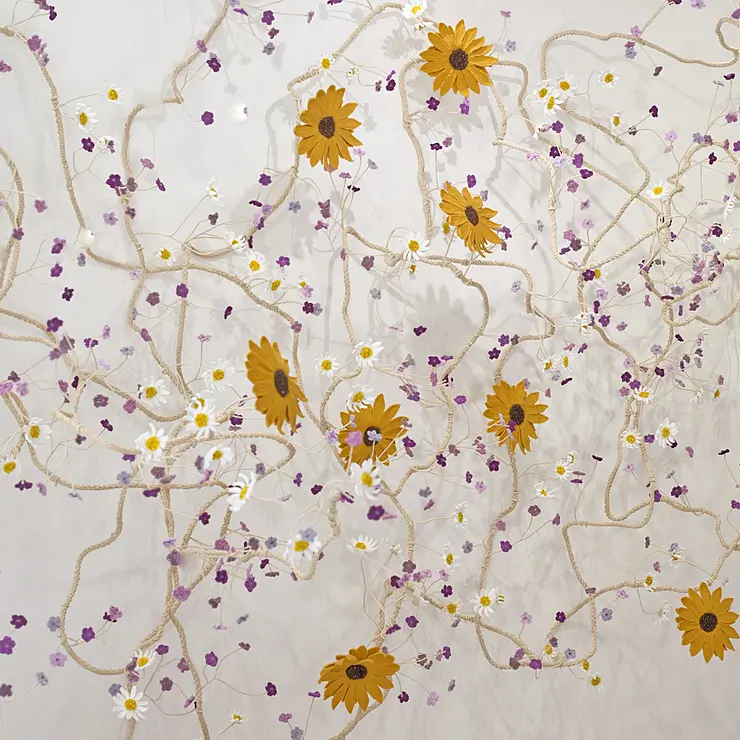
Nature is omnipresent in my work, particularly flowers. I am fascinated by both their beauty and their fragility. A flower is, by definition, ephemeral: it emerges, blossoms and eventually disappears. Through textiles, I try to do the opposite – to suspend it in time and preserve something that would naturally be destined to disappear. Ultimately, I create gardens that never fade.
View this post on Instagram
“I currently work from my studio, and my process almost always begins with observation. Nature is my main source of inspiration: flowers, trees and gardens, but also the shapes and colours that appear and transform throughout the seasons.
I do not work from photographs. When I choose a flower, I try to understand its construction – the shape of its petals, its centre, its volume and the way it grows – so that I can reproduce it as faithfully as possible through textiles. It becomes a process of interpreting nature through material and gesture. Then comes an extensive period of experimentation. I develop the techniques, samples and prototypes that will eventually allow me to construct the work. Some works require several hundred, and sometimes more than a thousand, hours of work.
I also have a few people who assist me with certain stages of production, particularly when hundreds of similar crocheted elements need to be made. I develop the patterns and prototypes that form the basis of their work. The entire conception of the piece, the research into materials and colours, the technical development, as well as the final composition and assembly, remain at the heart of my own practice.
I particularly love this idea of accumulation. For weeks or months, the studio gradually fills with hundreds of small elements made separately. Then comes the moment when I bring them all together and, little by little, the sculpture comes to life.
View this post on Instagram
“My new exhibition Symbiosis was born from the idea that an artwork should not simply be placed within a space, but should be able to enter into symbiosis with it.
The branches that form my sculptures are entirely flexible. They can be curved, extended and composed differently depending on the architecture of the space in which the work is installed. The same piece can therefore take on a different form from one setting to another while retaining its own identity.
This is also where my love of craftsmanship takes on its full meaning. Each branch becomes the support for a multitude of handmade elements created through embroidery, crochet, knitting and other textile techniques. I try to bring together two dimensions that might initially seem opposed: the precision and patience of craftsmanship with a sculpture that remains free, evolving and capable of transformation.
View this post on Instagram
“My interest in art comes first and foremost from my mother. From a very young age, she gave me the opportunity to travel extensively and to visit many museums, exhibitions and cultural sites. This greatly shaped both my curiosity and the way I look at the world.
Textiles were also present in my family – my grandmother was a seamstress and this helped shape my relationship with materials. Fashion came quite naturally afterwards. I began studying fashion in Paris at Atelier Chardon Savard. During my third year, however, I felt the need to deepen my understanding of materials and craftsmanship. I therefore decided to train in the art of embroidery with Marylène Eyral, who was living on Réunion Island at the time and is now based in the south of France.
That experience profoundly changed the way I approached creation. When I returned to my studies and continued through to my Master’s degree, I began developing much more experimental garments, creating my own materials by combining embroidery, knit, crochet and various textile techniques. Some of these experiments later received international recognition, notably through the Hand & Lock Prize in London.
View this post on Instagram
“What I enjoy most is probably watching an artwork gradually come to life through my hands. At the beginning, there may be nothing more than a thread, a material, a branch or a first flower. Then, over weeks or months, the gestures are repeated, the elements accumulate, and something gradually begins to emerge.
But my favourite moment is probably the installation. It is at that point that all the individual elements created separately over many months finally come together. The work leaves the studio, takes possession of the space and, for the first time, becomes truly complete.
View this post on Instagram
Need to Know: Yanis Miltgen’s exhibition Symbosis opens at SO Fine Art Editions on Saturday, October 3 to 31; Powerscourt Centre, 59 South William Street, Dublin 2; sofinearteditions.com
SEE MORE: Artistic License: Michael McGregor